Tag Archives: Christianity

Fight the Good Fight

I have studied, trained and taught karate’ and martial arts for nearly 30 years. It’s been a few since I’ve actively taught, but I have some insight I’d like to apply to Christian faith.

I taught my students to defend themselves. We never attack anyone else. We are not seeking to maim the opponent, but to protect life, friends and family from an aggressive attacker. Sadly, if you present weakness, there will inevitably be a perpetrator who seeks to take advantage of you.

Therefore, it’s important to train, to be aware of your surroundings, and to always be ready to defend yourself and your family. Now, this is true whether you apply it to faith, as I am about to, or not. The assumption that you’ll never be a victim of violence is foolish and unfounded. However, avoiding situations where violence may occur, maintaining 360 degree awareness at all times, and having a plan for self-defense and escape will minimize damage and potentially avoid conflict altogether.

If you are a genuine follower of Jesus, then you need to be prepared to defend your faith. Historic, biblical Christian faith is under sustained attack today, from Muslims, atheists and even nominal (not biblical) “Christians”. Sadly, too many supposed Christians are simply compromising or capitulating. They refuse to fight, or they give ground and hope they’ll be able to continue to live a comfortable life.

I don’t want to boil this all down to politics, because it’s deeper than that. However, in the last eight years, since the left gained control over the Presidency, this nation has moved farther from its Christian roots. Atheism is on the rise. Inordinate lifestyles and sexual choices have been normalized. Islamic extremism and it’s militant hatred for Christians has grown worldwide. What are Jesus’ followers to do? Certainly, those in free lands need to vote for candidates with biblical values. However, it appears so many in the USA are deceived that that may not be an option this election cycle. In fact, it appears we are in for four to eight more years of godless policies.

Fellow believers, our hope is not in this world. We must do more than provide ourselves and our families with comfortable lives. We must begin to live out our convictions, even and especially when that is not convenient, comfortable, or even safe. The reality is, our world is more dangerous than ever, and ignoring this fact does not change it. Confronting danger may seem scary, but it may actually be wiser than avoiding it until it becomes worse. We must learn to fight the good fight of faith.

“I have fought the good fight, I have finished the race, I have kept the faith” (2 Timothy 4:7). I hope, fellow believers, that we too may say what the Apostle Paul did here at the end of his life. For your own sake, that of your family and friends, and for the sake of our great nation, Jesus’ followers must learn to defend their faith against the attacks of the Enemy.

This begins by affirming that your faith is genuine, biblical and Jesus focused. The Apostle Paul challenged the Corinthians with this statement at the end of his second letter to them in the Bible. “Examine yourselves, to see whether you are in the faith. Test yourselves. Or do you not realize this about yourselves, that Jesus Christ is in you?—unless indeed you fail to meet the test!” (2 Corinthians 13:5, ESV) The essence of being a Christian is not in the externals, but whether or not the Spirit of God is living within you. The mystery of the Gospel is “Christ in you, the hope of glory” (Colossians 1:27). Is Jesus Christ alive in you? This isn’t a metaphor, friend. Do you have the Holy Spirit of God dwelling within your innermost being. Is Jesus really and truly in your heart?

If you doubt, then you need to stop where you are, at this moment, right now, and call on Jesus Christ in prayer. The Bible says, “whoever will call on the name of the Lord will be saved” (Romans 10:13). Talk to God and ask Jesus Christ to enter your heart and take control of your life. Do that sincerely and with all of the faith you can muster. “that if you confess with your mouth, Jesus is Lord, and believe in your heart God raised him from the dead, you will be saved” (Romans 10:9). “To has many as received him, to them he gave the right to be children of God, even to those who called on his name” (John 1:12). Call out to Jesus right now. Affirm that he is Lord, and give up your rights and give yourself to him.

So, is your faith real? Is Jesus really living within you? The next step is to learn and train to defend that faith in the face of opposition. We don’t attack people, we enter into spiritual warfare. That begins in your own mind. Combat doubt and ignorance by exposing yourself to the truth of the Bible, and by listening to believing teachers. Popular Bible teachers, even those with sound doctrine are not enough. As AW Tozer wrote, “I take my help where I find it and set my heart to graze where the pastures are greenest. Only one stipulation do I make: my teacher must know God, as Carlyle said, “otherwise than by hearsay,” and Christ must be all in all to him. If a man have only correct doctrine to offer me I am sure to slip out at the first intermission to seek the company of someone who has seen for himself how lovely is the face of Him who is the Rose of Sharon and the Lily of the Valley. Such a man can help me, and no one else can.”
(The Pursuit of Man, xiv).

We are instructed to be ready to defend our faith, and to do so with gentleness and respect for the person to whom we are making that defense. That begins with setting apart Jesus Christ as the one in control in your heart, “but in your hearts honor Christ the Lord as holy, always being prepared to make a defense to anyone who asks you for a reason for the hope that is in you; yet do ti with gentleness and respect, having a good conscience” (1 Peter 3:15-16a). We are also told to “speak the truth in love” (Ephesians 4:15). Our purpose is not to prove ourselves right and the other person wrong, nor is it to defeat or humiliate our opponent. Our purpose is to defend the truth of the Gospel before all people, and, if possible, to win our opponent over to faith in Jesus Christ, in order that they may be saved.

The real battle is against God’s great Enemy and our adversary in this life, Satan. You and I are not so significant that we’ll be fighting the Devil himself. We will encounter his lies and those influenced by him through those lies and through interaction with other fallen angels, whom we call demons. Once again, this battle begins in your own mind. Faulty assumptions, half-truths and outright lies comprise the basis of bad thinking. “For though we walk in the flesh, we are not waging war according to the flesh. For the weapons of our warfare have divine power to destroy strongholds. We destroy arguments and every lofty opinion raised against the knowledge of God, and take every thought captive to the obedience of Christ” (2 Corinthians 10:3-5). Change your thinking; change your ways.

You must renew your mind with the truth found in the Bible, and that must be illuminated, or properly interpreted and applied to your mind by the Holy Spirit. Read the Bible, or listen to it read, daily. You must take captive any thoughts that are contrary to the truth of the Bible. You must change any opinion that is contrary to the Word of God. You must not elevate any value or ideal above Jesus Christ and the clear teaching of the Bible. Consider what the Bible teaches about homosexuality, marriage, gender, the sanctity of human life. Don’t permit those who have been programmed with lies propagated through the media, the school system and government to sway you. Have compassion on those who are caught up in sin, but don’t compromise, accept that sin as God’s will and plan. Start with the sins of your own heart, though. Stop justifying, excusing or lying to yourself about them. Satan’s original lie to Eve in Eden was, “Did God really say…?” Yes, he did. It’s wrong. Cry out for strength, mercy and forgiveness. Repent.

Pray for understanding. Pray about what you read. Pray for yourself and others. Pray against the Enemy. Pray in preparation to speak with anyone about your faith. The battle is spiritual and we wrestle and win in prayer. “For we do not wrestle against flesh and blood, but against the rulers, against the authorities, against the cosmic powers over this present darkness, against the spiritual forces of evil in the heavenly places. Therefore, take up the whole armor of God, that you may be able to withstand in the evil day” (Ephesians 6:12-13).

Finally, engage others in the marketplace of ideas. Give personal testimony of your faith and what God has done and is doing in your life. No one can contradict authentic personal experience. Read and prepare to provide solid, reasonable answers for your faith and the truth of the Bible. Do not fear to talk to those who disagree. Remember, God will give you the words when you are speaking for him, “for I will give you words and wisdom that none of your opponents will be able to withstand or contradict” (Jesus speaking to the disciples in Luke 21:15).

Take action to protect your family and your friends against sin and evil. Limit what you expose your children (and yourself!) to through the media and online. The news media is biased against Christians. The entertainment industry promotes godless lifestyles and violence, colleges and public schools actively oppose the Bible and orthodox Christian faith, advertisers use sex and violence to sell their products, much of corporate America stands behind perverse values. It is time to stop supporting what is destroying faith in America!

Forewarned is forearmed. Learn to defend yourself, Christian. It’s only going to get worse. The good thing is, you’re not alone. God is your defender. “For you are my refuge, a strong tower against the enemy” (Psalm 61:3). We will win because Christ has overcome sin, death and hell. “If God is for us, who can stand against us? …No in all these things we are more than conquers through him who loved us” (Romans 8:31 & 37).


Coexist.

This world is a place where life with God and without God must coexist.

This is the case in order that people may clearly see the difference and decide whether they want to live with God for eternity. Those who live by faith in God and those who do not live side by side in this world.

The primary choice we are making over and over again every day is whether or not to believe in God.

If we believe, we live in light of that faith (James 2:14-26) and we seek to have a relationship with God. If we disbelieve, we incline to our own understanding of the world and live accordingly (Prov. 3:5). Unbelief is wrong because it separates us from the one who is good and right. “For whatever does not proceed from faith is sin” (Rom. 14:23). Unbelief has disastrous consequences, since it cuts us off from our Father and the hope of eternal life.

The contrasting lifestyles and states of wellbeing of genuine believers vs. unbelievers are clear indicators of the relative value of having a relationship with God. For example, a scientific study recognized that people who pray regularly are psychologically healthier than those who do not. The strength possessed by believers in the midst of tragedy and suffering is testament to the value of faith in God. Those who tithe their income are less materialistic, less controlled by money or the constant yearning for it.

So, why aren’t more people turning to faith in Christ? Don’t they see that this offers a better life and life after death? Are believers failing to show this to them convincingly? Or are they being deceived? Satan is the deceiver, and he is called god of this world.
“In their case the god of this world has blinded the minds of the unbelievers, to keep them from seeing the light of the gospel of the glory of Christ, who is the image of God.” (2 Corinthians 4:4, ESV)
I believe Satan has effectively deceived the world, including increasing numbers of Christians (Matthew 24:24).

To understand how Satan has accomplished this you must recognize that there are two worldviews at war in our nation today. The Christian worldview and secular utopianism. Currently, the delusion of secular utopianism is spreading. The Christian worldview has been under sustained attack by the proponents and leaders of secular utopianism since the 1800’s.

The Christian worldview is based upon the Bible. It is centered upon a faith in the God who created the universe, and made human beings in his own image. Its morality is based upon the will of God, who will judge the world. Its hope is in a coming new world where Jesus Christ will reign.

Secular utopianism, simply stated, is the godless pursuit of personal happiness in this world.

It is humanistic and seeks to make earth into heaven, and each human being into a god. It is based upon Satan’s ancient lie spoken to Eve in Eden.“But the serpent said to the woman, ‘You will not surely die. For God knows that when you eat of it your eyes will be opened, and you will be like God, knowing good and evil’” (Genesis 3:4–5, ESV). According to this worldview the only god who matters is you. It has adherents in every religion, but it denies the authority of the only real God and Creator of the universe. Yes, there are many who would call themselves Christians who are actually believers in this worldview. The Apostle Paul warns that these apparently religious people are, “having a form of godliness but denying the power thereof. Avoid such people” (2 Timothy 3:5).

Secular utopianism is a materialistic worldview, giving no credence, or at least no significance, to a real heaven beyond this world. Karl Marx is perhaps its most powerful proponent. Marx famously called religion opium because he believed it kept people from realizing they needed to fight to make this life and this world the only heaven there can be.

Marx wrote:
“Religious suffering is, at one and the same time, the expression of real suffering and a protest against real suffering. Religion is the sigh of the oppressed creature, the heart of a heartless world, and the soul of soulless conditions. It is the opium of the people.
The abolition of religion as the illusory happiness of the people is the demand for their real happiness. To call on them to give up their illusions about their condition is to call on them to give up a condition that requires illusions. The criticism of religion is, therefore, in embryo, the criticism of that vale of tears of which religion is the halo.”

Communism and Socialism promise to create a secular utopia by enforcing income equality and then by abolishing private property, but ultimately what is sought is the abolition of any personal opinion that does not conform with the ideology enforced by the state. We saw this in the failed USSR and we see it prominently in China and in North Korea. This is the direction the liberal/progressive movement is taking the USA.

However, the left is not alone in it’s pursuit of secular utopianism. It is the same on the far right. The free market capitalist’s favorite philosopher is Ayn Rand, who formulated the philosophy known as Objectivism, which is an intellectual justification of the self-centered pursuit of happiness. The reason capitalists love her is due to her support of a laissez-faire approach to capitalism, which permits market forces to work. However, unbridled free-market capitalism inevitably results in the abuses of which many  were victims during the 2008 financial crisis. This is the grist for Bernie Sanders’ popular grind against big corporations and income inequality.

So, neither the left or right have the answer to our problems, and neither can offer human beings what we really long for: love, purpose, lasting peace, fulfillment, the reason for our existence, which is God himself. Oh, but they try. You and I must follow the radical route, the narrow path, which will make none of our political and worldly friends happy.
“Enter by the narrow gate. For the gate is wide and the way is easy that leads to destruction, and those who enter by it are many. For the gate is narrow and the way is hard that leads to life, and those who find it are few” (Matthew 7:13–14, ESV).

Our culture has become toxic. It is imperative that we repudiate its godless values and protect ourselves and our children from being inculcated and indoctrinated. In order to do this our minds must be renewed by daily reading (or listening to) the Bible. We must be active in church. Jesus himself established the church, not a building or an institution, but communities set apart from the world to worship the One True God. The time in long past when a Christian could sit at home and rely on their own self-discipline and understanding of the Bible and expect to grow. Now, not only will you not grow, you will regress; you will fade into the light of common day; you will become more and more like the post-Christian culture, which has an inescapable influence on all of us.

Do you need examples of this influence? There is the obvious proliferation of pornography, available on every phone, tablet and computer. Our entertainment is filled with sexual immorality and violence. There is wide acceptance, even enforcement of the so-called rights of people to participate in perverse sexuality and distorted views of gender. Far more dangerous is the marginalization or outright rejection of Christianity in favor of the unbridled pursuit of self-satisfaction, pleasure or personal happiness. This is secular utopianism at work, and it is most dangerous when people believe that it is good, virtuous and right to pursue godless and distorted practices. Those who reject these practices as wrong and/or speak against them are considered evil and kept from expressing their offensive opinions in the public square, which was once a marketplace of free ideas.

The Western world is build upon the foundation of a Christian ethic and philosophy. The current preoccupation with secular utopianism has been labeled “post-Christian culture” by some observers. Author Mark Sayers, in his book Disappearing Church gives insight.
“Post-Christianity is not pre-Christianity; rather post-Christianity attempts to move beyond Christianity, whilst simultaneously feasting on its fruit.
Post-Christian culture attempts to retain the solace of faith, whilst gutting it of the costs, commitments, and restraints that the gospel places upon the individual will. Post-Christianity intuitively yearns for the justice and shalom of the kingdom, whilst defending the reign of the individual will. Post-Christianity is Christianity emptied of its content” (Kindle loc. 200)

This may help to explain why, in spite of all the evidence to the contrary, people still pursue heaven on earth. There is continues to be enough of a Christian remnant, and the remnant of its ethic, to keep us from descending into the outright evil of Nazi Germany or Stalinist Russia, and there is still enough temporary prosperity to keep us well fed and entertained. However, the widespread addiction to alcohol, illegal and prescription drugs (painkillers and anti-depressants) is testament to the fact that the pursuit of happiness is failing.

People who have a genuine relationship with Jesus Christ, must genuinely follow him. “Let your light so shine before people that they may see your good works and glorify your Father who is in heaven” (Matthew 5:16). What if you don’t reflect that light? What if you don’t shine? Then people cannot tell the difference between a Christian and a secular person. If that is the case, why would anyone want to waste time and energy devoting themselves to something other than themselves?

Worldly churches have little influence and lose members because they are no different from the culture. This is the case with churches where the Bible is distorted and disbelieved. Today many formerly large denominations are a shell of their former selves and a tithe of their former size because they have reinterpreted the Bible, rejected it’s authority and embraced contemporary cultural ethics. Then there are churches where relevance has taken precedence over the Bible. They may technically agree with orthodox Christian teaching, but they don’t emphasize anything controversial or counter-cultural. They teach practical advice and preach personal happiness. Some of these are churches where style and slick production is more important than biblical substance. In both of these types of churches—-the liberal, heterodox, or the surface conservative where relevance trumps all—people are unaffected by the truth of Christ. People leave, attend sporadically or live lives that are no different than their neighbors who do not go to church.

Those of us who are saved, are saved from this cursed world. We have been given hope in a life beyond our earthly existence. I am a new creation, set free from the three forces that kept me blind, lost and spiritually dead: the world, the flesh and the devil. The life I live on in this body on earth, I live by faith in the Son of God, who loves me and proved it when he died on the cross to save me. I must live this out daily. Then sinners will see and change their minds about God and about this world (Psalm 51:13).

The church of which I am Senior Pastor is called Lifewell for a reason. Jesus promised to make within each believer a wellspring of water overflowing with eternal life (John 4:14). That is God-quality abundant life. We want people to see this life lived through us and to be drawn to the God who gives it.

There is no good life apart from God, even non-believers benefit from the faith of God’s people. That is what is holding this rebellious, increasingly godless nation together at this moment.  Maybe what held your life together when you were in a state of rebellion and practical atheism was the prayers of a faithful grandma, or friends who refused to give up on you.
Believers are by no means given material advantages; in fact, the opposite may be true in many cases. However, the internal wellbeing produced by spiritual life within is its own reward far above wealth. God himself is the reward to his people (like the Levitical priests, cf. Deut. 18:2)

“Those who come to him must believe that he exists and he is a rewarder of those who diligently seek after him” (Hebrews 11:6).
See also, Isaiah 40:10, 62:11, Gal. 3:14, Col. 1:27, Eph. 3:16-21.
“As a deer longs for flowing streams,
so my soul longs for you, O God.
My soul thirsts for God,
for the living God.
When shall I come and behold
the face of God?”
(Psalm 42)

We live in a world where life with God and apart from God coexist. If you claim to know God, it is imperative that you live that life to the fullest, and live it openly. People who have no faith need to see the difference. Is there a difference in you? If not, you don’t really believe in this good and loving God, who sent his Son to give eternal life. Jesus promised to give a rich an satisfying life.

“The thief comes to steal, kill and destroy. I have come to give abundant life” (John 10:10).

Lent: Reasons to Fast

The season of Lent is a time many Christians choose to fast. For 2016 the season begins on Wednesday, February 10th

The following are some reasons for fasting, and not just for Lent. Fasting may be beneficial at any time.

1. Fast as an Act of Dedication–  Jesus went into the wilderness and fasted after his baptism and prior to entering into his ministry. Perhaps he did this to gain confirmation and clarity by intensely focusing on God.

2. Fast as an Exercise of Discipline–  Learn to say no to “me.” All of the temptations Jesus underwent in the wilderness were attempts to get him to act expediently and egotistically. If the Lord had given in it would not have been an exercise of faith, but, rather, the wildly alternating swings between self-doubt and presumption. I need to learn to say “no” to myself.

3. Fast as an Affirmation of Dependence–  Learn to rely on the power of God. Jesus’ first statement in response to Satan’s temptation demonstrates this. “Man shall not live on bread alone, but on every word that proceeds from the mouth of God” (Deuteronomy 8:3 as quoted in Matthew 4:4, also John 4:34).

4. Fast to Establish Determination–  Learn to have a tenacious and unshakeable faith. “This kind can only come out by prayer and fasting” (Mark 9:29, Matthew 17:21).

5. Fast as an Act of Desperation–  Cry out to God in repentance (Joel & Israel, Jonah and Ninevah). “Even now,” declares the Lord, “return to me with all your heart, with fasting and weeping and mourning.” (Joel 2:12 NIV). A need to hear from God at all costs (Daniel 10 & 21 days of prayer), David seeking the healing of his 1st child by Bathsheba.

6. Fast as a Means of Detoxification– Because of constant exposure to an impure environment your body collects all sorts of toxic and destructive substances. Consider Daniel and his friends who would not eat the meat and rich food offered them by their Babylonian overlords. Instead they ate only vegetables and drank only water. They were healthier as the result.

A vegetarian diet that allows only organic foods can be a healthy way to rid your body of toxins. When you fast, especially for longer periods, the digestive system and liver can rid you of accumulated poison.

The same principle applies to the mind. When you remove TV, movies, video games, godless music, social media, you give your mind the opportunity to rest. Replace these things with worship and saturation in Scripture.

7. Fast Regularly to Diet– Limiting the amount of food you eat is a means of controlling calorie intake. Most of us eat too much. We take in more calories than we burn off, so we gain unneeded fat. Periodic fasting if done in moderation and balanced with a healthy, calorie controlled diet, is an effective tool in losing fat and maintaining a lean body.

Whatever you decide to do, remember the following four principles.
A. If you make a commitment, keep it. Consistency is important for any discipline.
B. Choose something that will really require discipline to give up.
C. Giving up what you shouldn’t be doing to begin with is not fasting, it’s obedience.
D. It is not a good idea to make promises to God, better to rely on his promises for you. So, you aren’t fasting to get God to do something for you. Trust him to help you through.

What Is Love?

“Dear friends, let us continue to love one another, for love comes from God. Anyone who loves is born of God and knows God. But anyone who does not love does not know God—for God is love”

(1st John 4:7-8, New Living Translation).

What is love? Valentine’s Day makes this a pertinent question. My favorite writer on the subject didn’t get married until he was 58, and even then it was for charitable, not romantic, reasons. C. S. Lewis, the famous author of the Narnia series of books, married Joy Davidman in a government office to provide her with British citizenship. A few months later Joy was diagnosed with cancer, and her condition deteriorated rapidly. Jack, as Lewis was known by his friends, chose to love and care for Joy. The feeling between them grew, and nearly a year after the marriage of convenience there was a hospital wedding presided over by a clergyman from the Church of England. ’Til death do we part was a potent reality. Joy left the hospital to convalesce. It was not until this point that she moved in with Jack. God worked and Joy’s cancer went into remission. Jack and Joy lived happily for three more years. Then the cancer returned and took Joy. Jack wept.

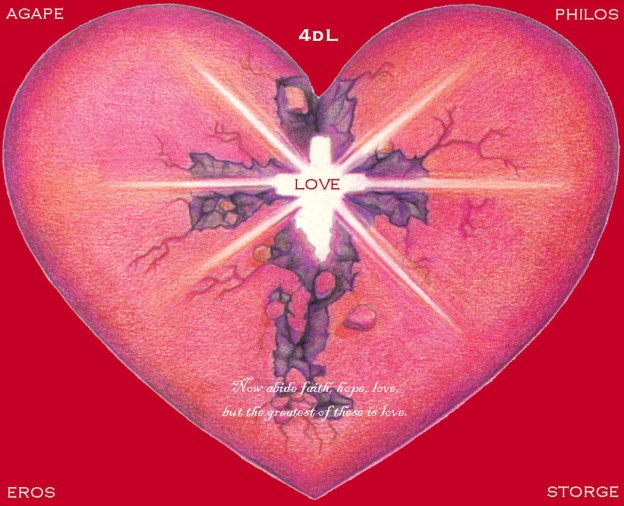
C. S. Lewis understood love as no one else whom I’ve read on the subject. At first this understanding was philosophical and academic. He wrote The Four Loves, an intelligent and insightful book describing the different types of love and their corresponding relationships. Lewis used Greek words to define each love. Agape’ is God’s unconditional gift love, exemplified in Jesus Christ’s sacrificial death on the cross. Philos is the love between family and friends, which the philosopher Plato called “the milk of human kindness.” Eros is erotic or sexual love, designed by God to connect one man and one woman for life. Finally, storge’ is what we would call affection. It is found in each of the previous three loves, expressing itself appropriately in different relationships.

C. S. Lewis lived out his creed. He was unlike like the men of his day, and his perspective is entirely foreign to us today. A breakdown of the timeline of Lewis’s relationship with Joy will reveal this.

Joy was a divorced American author seeking British citizenship when her visa was not renewed. Lewis gave her his name in a civil marriage to provide this. So, Jack, as Lewis was known to his friends,  entered into a relationship with Joy because he wanted to help a friend. This is agape’ love.

A friendship had also grown between Jack and Joy as they discovered common intellectual, literary and personal interests. The friendship deepened as the two pushed through life’s struggles together. This is philos love.

After Joy’s cancer was discovered she was hospitalized. At this point, Lewis realized something he hadn’t previously. He loved this woman as a man loves no other person.  Jack determined to express love to her on another level. He decided to marry her in eyes of the church, and asked a minister of the Anglican communion to perform the ceremony in her hospital room.

Afterward, Jack brought his beloved Joy home and began to care for her in earnest. The cancer went into remission, and the two lived together as man and wife, and enjoyed several years of happiness. It is important to note that the relationship between Joy and Jack did not become romantic or sexual until after the two were married in the eyes of God. This is eros love.

In the end the cancer returned and took Joy from Jack. Lewis had written several notebooks full of personal feelings and observations during this time, and anonymously published them in the book, A Grief Observed. It was a terrible loss for him and the book presents honest observations.

It was friendship and divine compassion (philos and agape’) that drew Jack and Joy together, love that sustained them in her illness, and it was the love of God that strengthened Jack in his grief when Joy was gone.

What is love?  It is indeed a “many splendored thing,” but fundamentally love is genuine compassion for another person. Love is the commitment to act in the best interest of the beloved, regardless of self-interest. Love must be the basis for every human relationship.

So, the next time you choose a friend or a lover, ask yourself:  is this about love, or something else? Then do what is good and right and God-like: choose to love.

Growing Again

I got off track. Okay, that’s a colloquialism, but it’s true. I am a preacher of the Gospel of Jesus, but I got away from my calling to preach Good News. Why? Reasons that I can think of: 1) Disappointment 2) Rejection from people I cared about, 3) Desire for things outside the will of God, 4) Disbelief that God wants to bless me.

Let’s begin with the last first. I’ve tried many things to get God to bless me. Early in my Christian life I made promises that I couldn’t keep. I’ve fasted, both food and other things. I’ve prayed, complained, journaled, read more and more of the Bible, served, given money, offered personal sacrifices. Nothing changes me, and that’s the real issue. I must change, but “a leopard cannot change its spots” and I cannot change my nature.

I’ve come to the realization that what I do and who I am doesn’t matter. It’s who God is that can change, well, everything– even me. That’s the nature of the Gospel. God is good and God loves me (and you) and God has done everything that needs to be done for me (and you) to be blessed and changed. We cannot change our natures, but God will… once we trust his love and goodness enough to permit Him to begin (and continue) that process of transformation.

I was saved many years ago at the age of 16. I made a deal with God that involved nothing more than taking him at his word. I was a lustful, sin sick teenager who heard the message that God loves me and accepts me “just as I am.” I tried to clean up my act, but was not able to measure up. I couldn’t eradicate the lust of my heart. When I heard the Good News that Jesus died for me just as I am to make of me what he wills, then I accepted the offer of life in place of my living death. So, the deal went like this: Lord, I cannot do this on my own; I cannot stop this lust in my heart. If you accept me as I am and you will help me, then you can have my life.

It’s interesting that even many years later I still default to trying to please God by trying to stop lust and sin as a precondition of his blessing. That’s not the deal I made with God, though; or, I should say, that’s not the deal He made with me (and offers everyone in the Gospel). God is good, apart from Him, I am not.

Don’t try to compare yourself to me, though. You might be tempted to say: “Well, I’m better than you. I’m not doing anything that bad.” You might be surprised to find that that isn’t true. Even if it is, Jesus is the example of what a human being is supposed to be, and I assure you, you’re not that good and moral. Or, you might say: “I’m much worse than you. I’ve done horrible things.” You might be surprised to know that God judges the heart above the action, and even when I’ve done nothing externally wrong, my heart is wicked and yearns for things that, even if the world accepts, God hates. So, I may have imagined it but never done it, and you have done it. The difference is whom you’ve hurt in addition to God and yourself, but we’ve both sinned.

The point is: God is good no matter what we’ve done, and he offers to make us right. First, he sees us as good and right, even though we aren’t, because Jesus became our sin and died in our place, debt paid, penalty served. Theologians call this justification or imputed righteousness. What it means is, because of Jesus God sees us as righteous, even while we are still struggling with sin. There are many places where this is taught in the New Testament. For example:

since all have sinned and fall short of the glory of God; they are now justified by his grace as a gift, through the redemption that is in Christ Jesus,” (Romans 3:23–24, NRSV)

For our sake he made him to be sin who knew no sin, so that in him we might become the righteousness of God.” (2 Corinthians 5:21, NRSV)

This is the basis of the Good News, the Gospel. Yet, although I’ve preached it every week, I still fell short of consistently living like I believed it. Why? Well, I said I had an issue believing that God wants to bless me. That resulted from a guilty conscience as I wrestled with lust and anger and other sin. Formulated into a statement, it would be: How can God love someone who desires this, or who has done that?

It goes deeper, though…

Are you ready for the real confession? I’ve always had a suspicion that God doesn’t really love me. Yes, “God so loved the world,” and I’m part of the world of people he loves. But that seems so general and impersonal. God loves everybody. I’m not disparaging that; I appreciate it. However, it didn’t translate into me feeling God cares about me personally. So, yes, I’ll get into heaven because of Jesus, for God loves the mass of humanity so much that he came and died. But what about “he died for me”? I believe God loves people; I just don’t think he really likes me all that much. Sometimes it feels like he doesn’t want to be around me. So, I feel neglected, sometimes abandoned, even though I’m saved.

I default to that because when we consider God in the natural, we are inclined to understand him to be like our human fathers. My biological father was absent; my step-father was distant. I wanted my step-dad to adopt me, but he wasn’t willing to ask me to take his name. I experienced rejection from both men. Additionally, I could never measure up to my step-father. He was a big man, bigger than life sometimes. I was a scared boy. He tried to help me. We studied karate’ together. He certainly didn’t need this; he did it for me. So, don’t think he was a bad guy; he wasn’t. I’m not disrespecting the man. However, I could never call him “Dad”. I always called him by his first name instead. I could call him my dad to other people, but never to his face. Why? He didn’t ever give me permission to.  Almost no one knows this, but when I was baptized as a teenager, I used my step-dad’s last name. I was looking for a Dad when I came to Jesus. And I found one in God the Father, but I have had a hard time sensing or receiving his love and acceptance.

In the natural I feel rejected, neglected, abandoned, unworthy of affection and incapable of measuring up, even at my age… That is how I’m inclined to feel about God the Father.  As a result, even though my thinking and theology teaches otherwise, I have a proclivity to act like I’m on my own living for God doing ministry for Him. Yes, I’m saved, and yes I’ve got some gifts the Lord has given, but I often feel I have to do it all myself.  This is the reason I’ve become so angry when things don’t work, or situations don’t work out, or when people have abandoned or opposed me.  I just feel like there is no one in my corner to to help me up or fight for me when I’m down. This has created a negative environment at times. And it does not indicate that I have the right quality of faith in the God of Jesus Christ.

However, that has not consistently been the case, and it has begun again to change. God is a good, loving and engaged Heavenly Father and the One whom Jesus gives me the right to call “Daddy.” I’ve begun to sense that once again as I’ve simply chosen to believe it in spite of my own sin.

Last year I began with a fast of several things; in fact, I encouraged our church to do the same. I continued saying “no” to one of these things for many weeks. This didn’t stop my lust, anger and other assorted attitudinal sins, though: only faith has helped.

These have indeed an appearance of wisdom in promoting self-imposed piety, humility, and severe treatment of the body, but they are of no value in checking self-indulgence.” (Colossians 2:23, NRSV)

The year was not one of growth, at least not on the surface. However, what I began to realize and internalize more deeply than ever is this: God loves me anyway. I’m not saying I believe he loves me and doesn’t care if I become angry or lustful. I’m saying, he loves me in spite of my sin and loves me enough to stay with me and work with me and help me overcome. That is a very big deal.

I’ve known and taught, nearly my whole ministry, that our lives must be God-centered rather than self-centered. Early on, I was profoundly affected by the book Pursuit of God by A.W. Tozer. I came to the conclusion that our greatest problem is self-centeredness, and that our greatest pursuit must be God himself, living a God-Centered life.

However, in reading this confession you can detect a lot of self orientation. That’s because knowing something, even teaching it, is not the same as realizing and living by it. That is what has begun to change over the last 6-12 months. Through the typical disappointments and failures, my faith has– are you ready for this?– grown stronger. This has not been the result of me overcoming my weaknesses, but of realizing God’s acceptance of me in the Beloved (in Jesus) IN SPITE OF MY FOOLISHNESS AND SIN.

The covenant I entered with God is the New Covenant, and it is not offered to those who are deserving, good and moral, but to those who recognize they are weak and in trouble. This Agreement with God was inked in blood, but not mine. Jesus signed it when he was crucified. I cannot fail because the New Covenant is in Jesus’ blood. He is the Guarantor. Not me. My part is to agree, to commit my weak self to Him, to open up and let His Spirit enter and do the lifelong work of transformation. I just need to trust Him, instead of myself. “Trust in the Lord wit all of your heart and do not lean on your own understanding” (Proverbs 3:5). I need to love Him, above myself. “He must increase but I must decrease” (John 3:30).

I fail my Father daily in big and small ways, but Jesus never falls short. His covenant of grace will always remain in place. He will never deny or forsake me. That is the Gospel, and it is very Good News.

What will be the result of this renewed realization? I am okay. I am secure. I am not easily angered or shaken. I will persevere in believing that God will bless and anoint and cause me to succeed in His work. I will not fail. Discouragement, disappointment, anger and doubt are all dissipating, evaporating like the dew when the sun grows warm. Hallelujah!

I am positive of this. It is not self-assurance or delusion, but faith.

“Now faith is the assurance of things hoped for, the conviction of things not seen” (Hebrews 11:1).

I am convinced. Faith is inherently positive, so I am positive. This will be a challenge in a darkening world filled with bad news, increasingly opposed to Christian faith. However, I am not afraid. I will not shrink back to destruction, but I will persevere in faith to the preserving of my soul in paradise and life eternal (Hebrews 10:39).

No, in all these things we are more than conquerors through him who loved us. For I am convinced that neither death, nor life, nor angels, nor rulers, nor things present, nor things to come, nor powers, nor height, nor depth, nor anything else in all creation, will be able to separate us from the love of God in Christ Jesus our Lord.” (Romans 8:37–39, NRSV)

Amen.

Mithra vs. Christ

From a published interview with historian Edwin Yamauchi.

“Nothing in Christianity is original” (DaVinci Code, Dan Brown).

Writers have claimed that a pagan mystery cult Mithraism is really the basis for Christianity. Actually, this is only one of several mystery cults that popular writers have associated with Christianity. Others are: Attis, Osiris, Adonis and Dionysus. However, the Persian god Mithras who was worshiped in the mystery cult called Mithraism is the closest parallel.

“Mithras… was born of a virgin in a cave on December 25, was considered a great traveling teacher, had 12 disciples, promised his followers immortality, sacrificed himself for world peace, was buried in a tomb and rose again three days later, instituted a eucharist or “Lord’s Supper,” and was considered the Logos, redeemer, Messiah, and “the way, the truth, and the life.”

How do you respond when people  present ancient “facts” like this?

What do you do once you’ve been told something like this?

Mithraism as a mystery religion cannot be attested before about AD 90.

“Gordon dates the establishment of the Mithraic mysteries to the reign of Hadrian, which  was AD 117-138.

Mithras was born of a virgin… No,the legend has it that Mithra was born out of a rock.

Mithras was born in a cave like Jesus…The New Testament doesn’t say Jesus born in a cave.

Mithras was born on December 25… Jesus was actually born in the Spring (Lk. 2:8).

December 25 was the date chosen by Emperor Aurelian for the dedication of his temple to Sol Invictus, the Roman god called “the unconquerable sun.” Mithras is sometimes depicted shaking hands with this god. It became the date Christ’s birth was celebrated in AD 336, the year before Constantine’s death, following the Christian practice of appropriating pagan holidays for holy use.

Mithras was a teacher with 12 disciples…. No, Mithras was a god.

Mithras’s followers promised immortality…. Inferred, but what’s new? That’s religion.

Mithras sacrificed himself…. He did not. He killed a bull.

Mithras buried and raised…. We know nothing about Mithras death, so there could be no resurrection.

Mithras was considered “Good Shepherd, Way, Truth and Life, Logos, Redeemer, Savior. “No… that’s reading Christian theology into this” Yamauchi

Mithras had a Eucharist meal…. Common meals shared in most religious groups.

Was a Mithraic rite called taurobolium the basis for Christian belief in Christ’s blood sacrifice for sins?

Taurobolium- initiate was placed in a pit with a grate over it and a bull was slaughtered above allowing the blood to baptize him.

It is an anachronism to base Christ’s sacrifice on the practice, since it is first attested to in the Attis cult in AD 160.

“Do you see any evidence that Christianity borrowed any of its beliefs from Mithraism?”

“Not really… they were rivals in the second century and later.”

So, my friends, not everything is as it appears on the internet!

Overcoming Anger, a Christian View

Anger is easy. There’s a lot to be mad about: some is justified; some is not; and too much is pointless. Anger is my default emotion, my drug of choice, if you will. When I get hurt, it makes me mad. When something doesn’t work the way it’s supposed to, it frustrates me and that results in anger (hence, my longstanding problem with technology). When I have to wait for something for what I feel is too long, that impatience results in anger (just experienced this with our abysmally slow internet connection). When people ignore me or reject me, it makes me angry. All of this bubbles up from the well of Pride, which is to say Original Sin. Pride expresses itself in manifold ways in different individuals, and this is an obvious way it comes out in my life.

In the Bible, James, the half-brother of Jesus and pastor of the first Jerusalem church admonishes, “The anger of man does not achieve the righteousness of God” (James 1:20). And yet, when someone cuts me off in traffic, when things don’t turn out as I expected, when I feel I am being treated unfairly, anger flairs and runs me, then ruins a portion of the day. This is wrong. Knowing that, however, doesn’t stop it from happening.

The results of human anger are devastating. Health problems may be caused or exacerbated by chronic anger. Depression is often the result of internalized anger. I may strike out in anger and injure someone physically or emotionally. Anger may even result in murder. Jesus clearly taught that anger leads that direction.
“You have heard that it was said to those of old, ‘You shall not murder; and whoever murders will be liable to judgment.’ But I say to you that everyone who is angry with his brother will be liable to judgment; whoever insults his brother will be liable to the council; and whoever says, ‘You fool!’ will be liable to the hell of fire.” (Matthew 5:21–22, ESV)
When I’m angry with another person because of a real or perceived wrong they’ve done to me, then I have the motive which may escalate to hatred and murder. Even though I can’t imagine myself killing someone, I am guilty of harming them in my mind and I possess the motive to do harm. Slander is character assassination, so even if I wouldn’t dream of killing the target of my anger, I may very well feel no compunction about ruining their reputation.

It is likely that anger constitutes an addiction. Now, don’t get me wrong: I’m not attempting to turn myself into a victim of genetics, or the poor choices of my youth. Every time I erupt in anger, I am making a clear choice. I am guilty. However, that doesn’t mean it is easy to control. In fact, I’m coming to realize that, like any addiction, fighting anger is futile because I’m fighting my own will. “A house divided against itself will not stand. This is made worse by the fact that I’m fighting anger with, well, more anger. What I must do is attack the basis for all of my anger, not just fight daily skirmishes against it’s myriad outbreaks.

The command and control center for anger, and for Pride, which is its basis, is the self. More specifically, “me” striving to live apart from the manifest presence of God. We weren’t created to live apart from God, and doing so has grave consequences. Anger is one of them.

My self must come to an end. It must die. I’m not suicidal, don’t worry. I’m not talking about ending my life but about ending the self-life. This includes: selfishness, self-centeredness, selfish ambition, even self-protection, manifesting as a constant need to defend the self. However, I cannot do this alone. No addiction can be eradicated without outside help.

“I have been crucified with Christ; and it is no longer I who live, but Christ lives in me; and the life which I now Iive in the flesh I live by faith in the Son of God, who loved me and gave Himself for me” (Galatians 2:20).

Jesus Christ came to earth to accomplish what you and I cannot alone. The Son of God took on the fullness of our humanity, lived the life we are supposed to, then took on the full weight of our sin. Then he died. I must die with him. I must be crucified with Christ. That is how the self-life comes to an end.

“If anyone is in Christ, they are a new creation. Old things have passed away; behold, all things have become new” (2 Corinthians 5:17).

Most importantly, Jesus Christ rose from the dead. In so doing he brought hope for a new life and a new self. Jesus told Nicodemus, “You must be born anew” (John 3:3). This may also be stated, “You must be born from above.” The resurrection makes that possible for everyone who will believe.

So, in order to overcome my anger, I must identify with Jesus Christ on the cross, through the grave, and in the resurrection. I must realize and remind myself daily, and even moment by moment, that I am a new creation in Christ. I have a new identity. No longer do I live my life apart from God. I’ve invited his Spirit into my innermost being, and a transformation has taken effect. I have a new nature. My thinking must agree with this reality.

When I agree with God’s Word and Spirit that I am a new person, that I have been re-created to be a “little Christ”, then the anger dissipates. It is replaced by a peace that surpasses understanding (Philippians 4:5-6), and by a humble confidence in God.

The Cure for Moral Insanity

What can cure the moral insanity spreading through our world?

Planned Parenthood (what a misnomer) is the largest abortion provider in the nation. They promote themselves as advocates for women’s health. What they actually are is a consumer corporation profiting from women who are facing the challenge of an unwanted pregnancy. They receive half a billion dollars from our government. But that’s not enough money for this greedy corporation. They call the human being in the womb “products of conception,” and ironically, they sell body parts from aborted fetuses as products for experimentation. The Nazis also experimented on human beings for “medical purposes” and used body parts from the unwanted human beings they murdered. Why do so many continue to support this evil corporation? Supporters are people driven by emotional pleas and political correctness, voting a party line rather than admitting the truth, having compassion or being concerned about the dignity of human life. This is sick. Why aren’t the decision makers being prosecuted? The same US government that protects the egg of a bald eagle ensures permission for unborn humans to be ripped from the womb one body part at a time. This is moral insanity.

The U.S. created a power vacuum in the Middle East because of the 2003 Iraq invasion and the weary withdrawal of US troops after a decade of attempting to assist in creating a fair democracy. This vacuum is now being filled by the most evil men the world has seen since the days of Hitler, Stalin and Pol Pot. Islamic extremists have yet to murder as many people as those dictators, but they possess the will to do so. ISIS is attempting to establish a Caliphate or religious government that wills to take over the world. They revel in spectacular executions, slavery of those who don’t believe their doctrine, rape as a form of worship and the destruction of ancient history. All of this evil is calculated to serve one goal: terrorize the world in an effort to subdue it. This is moral insanity.

ISIS butchers thousands of people, and the U.S. response has been timid and tepid. Christians are martyred like they were in the Roman Colosseum, but in place of thousands of spectators in the stands there are multiple millions of viewers on the internet. Why are their videos hosted? Why are they permitted to promote their evil? Social media giants like Facebook and Twitter could do more to shut these people out, but instead they tacitly support the evil they allow to be promoted via their networks. The news media covers ISIS in graphic detail because it draws more viewers. In so doing, CNN, MSNBC, FOX become the de facto PR team for ISIS. Terror is their tool, publicizing their activities, ideas and videos gives them the worldwide stage they desire to spread fear and horror. This is moral insanity.

The United States leads the world. The culture here is a powerful influence everywhere. Sexual immorality has become the norm in our culture. The family existed prior, not only to our government and our nation, but prior to civilization itself. It is the fundamental building block of civilization. Now that ancient institution is under sustained attack by a perverse and powerful lobby. What was once considered shameful has been institutionalized by the highest court in the land. Marriage has been universally understood to be the bond between one man and one woman. That five unelected judges changed the definition of a 5000 year old institution should be deeply disturbing to everyone. Every child needs a mother and a father. To establish a norm that deprives children of this is moral insanity. However, the problem of single parent homes did not originate within the LGBT community. In fact, fatherless homes may well be the most significant cause of the sexual confusion in which we find ourselves in today.

The ideal is that the marriage bond lasts for life. Divorce became more and more accepted in the mid 20th century. Now it is as common as marriage. The once expected standard of waiting to have sex until marriage has been replaced with rampant sexual promiscuity. Cohabitation is the norm. The internet has made pornography instantly accessible to almost anyone. It is not surprising that this fertile ground for sexual immorality has produced increased acceptance for inordinate and perverse forms of sex. Consider the popularity of the book series titled 50 Shades of Gray, wherein the rich misogynistic male protagonist gets off on treating his female partners like sex slaves, and the female protagonist enjoys such treatment. This is moral insanity.

Then there is the explosion of gun violence in the US. Why? Policy makers and politicians wring their hands, or point their fingers at one another, but fail to make any changes. The left sees this as a problem with the proliferation of guns, so they propose gun control laws. The right sees this as a problem solvable by the exercise of the 2nd Amendment right to keep and bear arms. Their solution is to arm law abiding citizens. Guns merely make violence more convenient and more glamorous. I wonder how many of the same individuals who support gun control would oppose controlling the sale of violent video games to kids? Why do NRA and 2nd Amendment advocates oppose attempts to keep guns out of the hands of the untrained? Not everyone should have the right to carry a gun. The unfortunate problem is, those who choose to break the law are not going to train or get their guns registered. What we have is a social problem that is signified, and perhaps exacerbated, by guns, but not caused or resolved by guns or their removal from the hands of law abiding citizens.

The real issue was revealed by Jesus Christ when one of his disciples wanted to protect him from harm. On the night before his crucifixion, Jesus was in the Garden of Gethsemene praying when Judas Iscariot arrived with a crowd of men with swords and clubs. The traitor identified his former master with a kiss and the guards grabbed Jesus. Peter drew a sword and struck the high priest’s servant, severing his ear. Jesus healed the servant’s ear and admonished Peter saying, “Put your sword back in its place. For all who take the sword will perish by the sword” (Matthew 26:52, ESV). 

Guns are neither the problem nor the answer. The issue is in the heart of human beings, for evil comes out of the heart. In this case it is the evil of treating other persons as objects, obstacles that threaten us or stand in our way. Video games provide an apt example: when you encounter a person who threatens you or stands in the way of your progress, you typically just shoot them dead. But persons are created in God’s image. Why aren’t we bothered when human beings are treated with less respect than our pets?

This reveals an even deeper heart problem: the failure fear God, to believe in a just and loving God, who says, “Vengeance is mine. I will repay… For we must all stand before the judgement seat of Christ, so that each one may receive what is due for what he has done in the body, whether good or evil” (Romans 12:19b, 2 Corinthians 5:10).

In an unprincipled, increasingly lawless, population every person looks to himself to determine right and wrong.  The serpent promised self-determination to Eve in the Garden when he tempted her to eat the fruit from the tree of the knowledge of good and evil. “You will not die; for God knows that when you eat of it your eyes will be opened, and you will be like God, knowing good and evil.” Eve and Adam gave in to the temptation and were cast out of God’s presence. Self-determination (apart from God) has continued as the norm of human nature throughout our history. It was exemplified during the period of Judges in Israel when the people did great evil. The explanation for that evil is found in the final verse of Judges: “In those days there was no king in Israel. Everyone did what was right in his own eyes” (Judges 21:25).

When someone rejects God as their king, they do so in order to rule over their own conscience and life (see Psalm 10:4, 14:1). They become blind to sin and evil, following the dictates of their own godless heart. “Transgression speaks to the ungodly within his heart; there is no fear of God before his eyes. For he flatters himself too much to detect or hate his own sin” (Psalm 36:1-2).

The law is for the lawless. There is a God who has created the universe the people who live in it. The universe operates according to the constant and unchangeable laws of physics, and human beings are created to live within the parameters of the the moral law, which the Creator also established. This is obvious to anyone who would bother to pay attention and pursue the evidence instead of their own agenda. “For what may be known about God is evident within them for God has made it evident to them. Ever since the creation of the world his invisible attributes, his eternal power and divine nature, have been clearly perceived through what has been made, so they are without excuse” (Romans 1:19-20). 

There are elementary moral principles present in everyone’s conscience. However, we live in a fallen world in active rebellion against those principles. This confuses people and distorts the subjective perception of truth in their consciences. “There is a way that seems right to a man, but in the end it leads to death” (Proverbs 14:12). Therefore, God made the moral law objectively plain to his people Israel on Mount Sinai. Then he sent his Son to live out the truth and offer a way for everyone to receive and live eternal life. “For the Law was given through Moses; grace and truth were realized through Jesus Christ… I am the way, the truth and the life. No one comes to the Father, except through me” (John 1:17, 14:6).

The cure for moral insanity today is a King and a Law. “Where there is no vision the people are unrestrained. But happy is he who keeps the law” (Proverbs 29:18). For people who genuinely believe in and follow the God of the Bible, there is moral sanity. However, for those who do not live their lives surrendered to God, the Law is in place to teach them right from wrong and threaten punishment for violation.
“…understanding this, that the law is not laid down for the just but for the lawless and disobedient, for the ungodly and sinners, for the unholy and profane, for those who strike their fathers and mothers, for murderers, the sexually immoral, for the effeminate and homosexuals, enslavers, liars, perjurers, and whatever else is contrary to sound doctrine” (1 Timothy 9-10).

We must encourage and reintroduce the truth of the Bible to people, in order that many may return to faith, which at its basic level is reverence for God. “The fear of the Lord is the beginning of knowledge” (Proverbs 1:7). Next, there must be a fair and gracious application of God’s Law, which is objectively defined in the 10 Commandments. There must be legitimate and just authority in place to establish and enforce laws on this basis. These commandments teach and mandate respect for God and respect for other people.
1- You shall worship no other God, except me.
2-  You shall not make any idols.
3-  You shall not misuse my Name.
4-  Observe the Sabbath and keep it holy.
5-  Honor your father and mother.
6-  Do not murder.
7-  Do not commit adultery.
8-  Do not steal.
9-  Do not lie.
10- Do not covet.

The first four Commandments focus on God and should be left to God’s people to teach and enforce among themselves. Civil law and authorities should protect and ensure that expressions of faith in God are unhindered and unmolested, and that every person is free to worship God, or to refrain from worshipping, according to his or her conscience. Most importantly, there must be no law passed to prohibit the preaching and teaching of the Bible. That is where truth, freedom and salvation is found.

The last six commandments should form the basis for civil law. Society’s laws will need to expand upon, but should still find their basis in, these six basic commands.

Those of us who claim to believe in and follow Jesus Christ must lead the way. The following admonition reveals what will restore sanity to us.
“For the Lord has not given us a spirit of timidity, but of power, and love and a sound mind.”
(2 Timothy 1:7)
The word translated timidity is sometimes rendered as fear, but the lexicon helps us understand it further by defining it as: “a state of fear because of a lack of courage or moral strength” (Louw-Nida Greek lexicon). We who would claim Christ as our Lord must have the courage to live out our moral convictions. There must be no compromise with the godless values promoted and enshrined in our nation. “Do not participate in the unfruitful deeds of darkness, but instead even expose them” (Ephesians 5:11). 

We must not be timid about taking a stand against the moral insanity spreading through our nation and the world, even as it becomes socially acceptable, even if we are castigated and persecuted for the stand we take. We must “speak the truth in love,” and “be ready always to give an answer for the hope that is within us, yet with gentleness and reverence” (Ephesians 4:15, 1 Peter 3:15). This is important if we ever expect to bring our nation back from the brink of moral breakdown, but it is even more important for each of us to have courage for the sake of our own moral sanity.

We do not do this alone. The Holy Spirit will fill us with courage, and will remind us of God’s words when the time comes to speak (see John 14:26 & Luke 12:11-12). So, rest; do not be anxious or afraid. Do the right thing always, and be ready to defend your moral choice by appealing to the Lord Jesus as your teacher. Do not be ashamed of the name of Jesus or of his Gospel. “For I am not ashamed of the Gospel, for it is the power of salvation to all who believe, for the Jew first and also the Greek” (Romans 1:16).

Let us pray for nothing short of a Great Awakening in this formerly great nation.

Are Christians Becoming Stupid?

“Let anyone with ears to hear listen! And he said to them, ‘Pay attention to what you hear; the measure you give will be the measure you get, and still more will be given you. For to those who have, more will be given; and from those who have nothing, even what they have will be taken away.’”

(Mark 4:23-25)

Not all Christians are stupid, and I do not use the term in a derogatory way. I use it advisedly to both get your attention, and to point out that many who would claim the name Christian, who once accepted the truth of the Bible and sought to live accordingly, have now willfully chosen to eschew that knowledge in favor of many opposing views. They could hear, but have now chosen not to pay attention.

Ignorant refers to someone who simply doesn’t know, or know any better. Stupid refers to someone who knows better than, say, to do something, but charges headlong into doing it anyhow. Stupid is someone who knows the truth that sets them free and remains instead a slave. Increasing numbers of Christians are in this position because they have chosen to be shaped by a post-Christian culture instead of having minds transformed by paying attention to and applying the truth of the living and active Word of God.

Pay attention to what you hear; the measure you give will be the measure you get…

I wrote the next two paragraphs like a journal entry when I encountered Jesus words about paying attention to what you hear. You see, I need to get this.

Measure you give = how much I pay attention to the Word being spoken. Measure you get = how much truth I receive and retain. I don’t want to be like those “who are always learning and never coming to the knowledge of the truth.

When I listen, focus, pay attention to the Word being communicated through the Scripture by the Holy Spirit, or the internal witness or conviction of the Spirit about some issue, then I will realize the truth being communicated. I will receive knowledge. Then I will act on the truth. If I do this, then I will retain what I’ve learned (remember it) and remain active in it (continue to act upon it), and I will be in position and privileged to receive more truth from the Lord. If I fail to pay attention, to believe in and act upon the truth the Holy Spirit is teaching, then I will not be given anything more. Not only that, what I’ve already learned will begin to leech away until I have nothing. I must live out what I’ve learned, and keep learning more. I must move upward and go forward and grow and change into the image of Christ, or I will fall backward and become more and more like a fallen man, who “fades into the light of common day.”

I think some of you need to understand this too…

Jesus told parables. These are “earthly stories with a heavenly meaning.” In relating the reason he spoke in parables, this master teacher indicated it was in order to hide the truth from the uninitiated and those unwilling to change (see Mark 4:10-12). He explained his parables to the followers he chose. The beauty of Jesus’ parables is, they are memorable and tangible and may be recalled by anyone who has heard them even once. However, the meaning is not obvious; it requires an instructed mind, a mind taught by the Holy Spirit. This represents the Lord hiding the Truth in plain sight. The genius of the parables is, the truth remains locked up inside them ready to be revealed when the person who has heard decides to pay attention. “For him who has ears to hear, let him hear,” is a command Jesus appended to many of his parables and other teaching. It is like a zip file on a computer: that small file contains a compressed information which must be unzipped, or decompressed, in order to be understood by a user. A parable of Jesus, like that zip file, is stored in the memory of someone who has heard it. When once that person is ready to pay attention to the Holy Spirit, who is trying to speak to them and transform them, there comes a moment of serendipity (an Aha! moment) when they realize the truth (like “the moral of the story”).

Truth demands a response, a parable containing truth does not. The more people hear Truth and refuse to accept it, the harder their hearts become to it. Jesus was encountering opposition and hardening hearts when he began to use parables. Eventually, the truth must be told explicitly, without figures of speech and stories (see John 16:19-33), and the Spirit of Truth will make it plain to those who are paying attention. Are you paying attention?

If you pay attention and receive what you hear by faith, then you will learn and grow. You will be entrusted with more truth and more knowledge of God and His Word. If you do not, then even what you once had will be taken away from you. You may well fall into a horrible state of disbelief, and, well, stupidity regarding God and the Bible. You may come to a point of no return, a place where you seek to repent but cannot change your heart and mind back to the simplicity of trust in Jesus and belief in the Bible as God’s holy Word. It is pointless for me to warn anyone who has already come to such a point. Such a person will scoff, discount, ignore or argue against such a warning. I am speaking to someone who has yet to turn away, but may be tempted.

If you are being tested today, if you feel like turning away, I say come back home. Return to the beginning of your faith journey. You’ve become to wise in your own eyes. You don’t know what you think you do. The truth hasn’t changed. Jesus is the same and His love is never ending. Return to the place where you began to stray. Do what you refused to do back then. Go back to the place where you began to do what you still know is wrong, and repent. Change your thinking and change your ways, while you still can. “Night is coming when no man can work,” and no more change may be made.

Here’s a final warning from Scripture. Heed it, and don’t be stupid.

“For it is impossible, in the case of those who have once been enlightened, who have tasted the heavenly gift, and have shared in the Holy Spirit, and have tasted the goodness of the word of God and the powers of the age to come, and then have fallen away, to restore them again to repentance, since they are crucifying once again the Son of God to their own harm and holding him up to contempt.” (Hebrews 6:4-6)

 If you

Homosexuality and the Bible

It is obvious to me when reading the online comments of several professed Christians that culture is having a greater influence upon their thinking than the inspired Scripture. And it is equally obvious by references these people make to the Bible that many don’t really pay attention to what it very plainly says.. Rather, they rely on others who have read key passages to (re)interpret what it says about homosexuality. Additionally, I see increasing instances of people disrespecting the Apostle Paul and discounting what he wrote as irrelevant for a 21st century context. What is even worse is the assertion that Paul is teaching a different Gospel than Jesus! Because if you can dismiss the Apostle Paul, then you’re left with a much depleted New Testament, and a far less defined Gospel.

I’m not going to make the attempt at the moment to defend Paul. If you claim to be a follower of Jesus, then you dismiss Paul at your own risk. Jesus Christ himself appeared to Paul in the road to Damascus, and called him to be the Apostle to the Gentiles. That means he’s the key communicator for the overwhelming majority of us. Further, Paul started churches and set precedent for how churches should be formed, which arguably continues to bear fruit today. See, I couldn’t leave it alone! I will proceed with the same faith passed down to the saints from the beginning: the Gospel distilled and proclaimed by Paul, Peter, John and at least four other New Testament writers.

But, just to make a point, let’s start with Jesus, whom many make the case never addressed homosexuality. Actually, Jesus taught about something more important than sexual choice, he taught about God’s design for gender and human relationships. Most importantly for this discussion, Jesus affirmed Old Testament teaching about marriage.

Matthew 19:3-6
“And Pharisees came up to him and tested him by asking, ‘Is it lawful to divorce one’s wife for any cause?’ He answered, ‘Have you not read that he who created them from the beginning made them male and female,’ and said, “Therefore a man shall leave his father and his mother and hold fast to his wife, and the two shall become one flesh”? So they are no longer two but one flesh. What therefore God has joined together, let not man separate.’”

The one flesh relationship that Jesus affirms is part of God’s design in creation. In fact, the Lord quotes from the creation account in Genesis (2:24) in his reply to the Pharisees. I think Jesus might say the same thing to us today regarding the issue of marriage: “Have you not read…?” God intentionally designed and created two different genders, male and female. Sex is part of God’s design and the physical connecting link between the man and woman who commit themselves to each other in marriage. It is also the procreative tool to bring about new life. When a man and a woman join together by covenant and in sexual union, they become one physically, emotionally and even spiritually. The one flesh relationship God designed is impossible between two people of the same gender. This should be anatomically obvious to anyone who considers it.

It has become culturally acceptable for men and women to act like the opposite gender, and even to have themselves surgically and chemically altered to resemble the opposite gender. However, God’s design is deeper than that. We are living in a fallen world and there are some who are born with characteristics of both genders, and others who never feel comfortable living out their genetic gender. “God created them male and female.” Each one of us is created to be either male or female, outside and inside. Perhaps the person born with both characteristics is a good illustration of the “inside” gender idea. That individual must chose to live as a male or a female and will choose what they are inside as opposed to living according to their ambivalent or confusing anatomy.

You are either male or female. God designed you to be that gender. Physically and emotionally and spiritually you will become more and more a man or more and more a woman.

It is not God’s will for everyone to marry. Observe what the Lord taught us about divorce. The disciples were surprised about his strict interpretation.

Matthew 19:10-12
“The disciples said to him, If such is the case of a man with his wife, it is better not to marry.” But he said to them, “Not everyone can receive this saying, but only those to whom it is given. For there are eunuchs who have been so from birth, and there are eunuchs who have been made eunuchs by men, and there are eunuchs who have made themselves eunuchs for the sake of the kingdom of heaven. Let the one who is able to receive this receive it.”
A eunuch cannot have sexual intercourse with a woman. Some men are born this way, some were conscripted and surgically altered as children, and others may choose to remained celibate.

There is a pattern and a principle here. If you are a man and are not attracted to women, or if you are attracted to other men instead, then it is incumbent upon you to remain celibate, not to presume that God made you to be a homosexual. We are living in a fallen world and I have no doubt but that there are complex factors at work in the lives of those who have same sex attraction. However, sex is not the answer to same sex attraction. You may genuinely love someone of the same gender. Good! But sex is not love. You find yourself in the same position as the eunuchs Jesus taught about above, and the same situation as any unmarried person with heterosexual attraction. You can abstain. Nothing bad will happen if you do not act out on your sexual attraction and desire. However, it will be very bad if you determine to identify with homosexuality and act against God’s design for male and female.

Let’s look at what Paul had to say in his letter to the Romans. This is an important inspired document. It was written to the capital city for the entire Roman empire. Paul distilled the Gospel and presented it very clearly in Romans. The epistle starts with a presentation about the world’s number one problem: sin. This is a longer passage, but read it carefully. I want you to understand the flow of the Apostle’s inspired reasoning.

Romans 1:18-27
“For the wrath of God is revealed from heaven against all ungodliness and unrighteousness of men, who by their unrighteousness suppress the truth. 19 For what can be known about God is plain to them, because God has shown it to them. 20 For his invisible attributes, namely, his eternal power and divine nature, have been clearly perceived, ever since the creation of the world, in the things that have been made. So they are without excuse. 21 For although they knew God, they did not honor him as God or give thanks to him, but they became futile in their thinking, and their foolish hearts were darkened. 22 Claiming to be wise, they became fools, 23 and exchanged the glory of the immortal God for images resembling mortal man and birds and animals and creeping things.
24 Therefore God gave them up in the lusts of their hearts to impurity, to the dishonoring of their bodies among themselves, 25 because they exchanged the truth about God for a lie and worshiped and served the creature rather than the Creator, who is blessed forever! Amen.
26 For this reason God gave them up to dishonorable passions. For their women exchanged natural relations for those that are contrary to nature; 27 and the men likewise gave up natural relations with women and were consumed with passion for one another, men committing shameless acts with men and receiving in themselves the due penalty for their error.

I left the verse numbers so that you can find what I comment on.

First, God’s righteous anger is demonstrated against all sin (v. 18), not just sexual sins, and not just certain sexual sins. People who live sinful lifestyles suppress the truth (v. 18)—sin as defined by God in the Bible, and clearly in this Epistle to the Romans. To suppress means they try to hold the truth down, cover it up and keep people from hearing it, or argue against it. People suppress the truth with words and with their actions and lifestyle choices. That describes a variety of ways advocates energetically defend homosexuality and same sex marriage today. It has been cast as a civil right, and same sex marriage is “marriage equality.” Who wants to deny someone equal rights? Do you want to be on the wrong side of history? In one sense we’re all on the wrong side of history, until Christ returns and establishes righteousness and justice on the earth.

Because many Christians oppose homosexuality and support traditional marriage, a number of outspoken LGBT groups express outrage, sometimes even hatred. Apparently Christians don’t have the right to speak or exercise freedom of conscience. Activists shout down and attempt exclude anyone who doesn’t agree with their opinion about homosexuality. Do you need reminding about the Atlanta fire chief who was dismissed for at statement in support of traditional marriage, or of how national Christian speaker Louie Giglio was pressured by the gay lobby to turn down an invitation to pray at Obama’s inauguration because of something he said in a sermon against homosexuality many years earlier. And do you remember the Chik fil’ A brouhaha and boycott? All because the mild mannered founder supported traditional marriage. Suppressers are not supporters of free speech… unless they are the ones speaking.

Everyone is accountable to God because God has revealed himself in some way to everyone, both in their conscience and in creation (vv. 19-20). Suppression of the truth continues: Is it any wonder that many who reject God embrace a worldview that teaches everything came from nothing as the result of pure chance, and “There is at bottom no design, no purpose, no good, nothing but pointless indifference” (Dawkins). Every living thing is the product of the blind force of natural selection. This certainly leaves a gaping hole, through which any random idea or set of values can come, and indeed have come. If you begin with the provable assumption that the world is designed, created by an intelligent mind, then the next step is to understand the design and discover how you fit into it.

Even though we have all seen evidence of God in ourselves and in the created order, we all rebel and refuse to acknowledge Him in our thinking (v. 21). There is a biblical Proverb that says, “Trust in the Lord with all of your heart and do not lean on your own understanding. In all of your ways acknowledge him,and he will direct your paths” (Proverbs 3:5-6). No, we put God out of our minds and think and do whatever we please. We think we are so wise! Further, we are ungrateful for all that the good and loving Creator has provided and done. The result is idolatry. We idolize things, people, and most of all, self (vv. 21-24).

Now let’s focus on those last two verses, which clearly describe homosexuality, even though they do not use that term. In fact, that has been an argument used by the pro homosexuals who try to use the Bible to buttress their position, or disabuse it in a continued effort to suppress what it says. The argument goes like this: The word “homosexual” is never actually used, so what we call homosexuality is not wrong. Actually, more descriptive and graphic words are used to describe and define the behavior. We often use the English word “homosexual” to gather these ideas together.

The Apostle Paul observes the ancient world and states (Romans 1:26-27 again),
“For this reason God gave them up to dishonorable passions. For their women exchanged natural relations for those that are contrary to nature; 27 and the men likewise gave up natural relations with women and were consumed with passion for one another, men committing shameless acts with men and receiving in themselves the due penalty for their error.

Once someone gets to the place where they choose an active lifestyle of sin, rebellion and perversion, it is the because they have stopped responding to God who has been convicting their conscience about right and wrong. Eventually, the person who chooses such a lifestyle hardens their heart to the point that they no longer respond to God’s urging. So, he gives them up to their desires (v. 26). Among these may be a burning desire to do sexual things with the same gender. Women are said to exchange natural sex with a husband for disordered sex with other women. Men are said to burn in their passion for other men. I believe that this is an expression of self-love and selfish idolatry.

I have come to believe that, at it’s root, homosexuality is an attempt to love and worship the self. A gay man sees another like himself, projects himself onto that person and makes love to them, and in so doing loves himself. This is partly what sex is, a means of obtaining acceptance and love. The perversion with homosexuality is the inability or unwillingness to completely love the other. I’m not saying that a lesbian couple cannot love one another (not sex, but compassion), but I am saying that the sexual side of homosexual relationships is very self-involved. The homosexual may project onto someone who is very much like themselves, someone who has similar physical features, and then show affection to that person and try to become physically intimate with them in an attempt to love themselves. In a different case a homosexual may project themselves onto an ideal person, someone they wish they were like, and make them the object of affection, in which case they are compensating for what they feel they lack. Now, this is my theory; you may criticize or jettison it as you’d like. I’m trying to understand homosexuality as it relates to sex itself.

The Apostle Paul stated in Ephesians 5:28-29: “So husbands ought also to love their own wives as their own bodies. He who loves his own wife loves himself; for no one ever hated his own flesh, but nourishes and cherishes it….” It is evident, then, that sex is a means of self-love. The man and woman become one flesh, and when they have intercourse, they are expressing love each for the other and for the self as they identify with the other. The problem with homosexuality is both, that it cannot result in a one flesh relationship, and that it is expressing love for what amounts to an ideal image in the mirror of another just like me or like I want to be.

Whatever the root and reason for homosexuality, it is inherently unfulfilling. The homosexual receives in her/his own body the due penalty for their error (v. 27). Same sex marriage, social acceptance, or pleasurable sexual experiences: none of these will fill the emptiness. Homosexual activity merely exacerbates the loneliness and inevitably results in pain, loss, depression, isolation, despair. Whatever the psychological, emotional and physical consequences of homosexual behavior, it is sin. All sin separates from God, and without God we are all empty and headed for destruction.

There are two other New Testament passages of Scripture about homosexual behavior and relationships. Like the passage above, homosexuality is not treated alone. It is listed alongside other sins.
The Apostle Paul indicates that the Law should be taught or preached to those who are acting lawlessly so that they will be given an opportunity to realize that they are wrong.

1 Timothy 1:8-11
But we know that the Law is good, if one uses it lawfully, realizing the fact that law is not made for a righteous person, but for those who are lawless and rebellious, for the ungodly and sinners, for the unholy and profane, for those who kill their fathers or mothers, for murderers and immoral men and homosexuals and kidnappers and liars and perjurers, and whatever else is contrary to sound teaching, according to the glorious gospel of the blessed God, with which I have been entrusted.”
The word for immoral is “pornos” in Greek and likely refers to the sexually immoral, of which the next word is an example. In the NASB, the Greek word “arsenokoites” is translated “homosexual.” In the NRSV and the NKJV it is rendered “sodomites.” It is a highly descriptive term that refers to more than mere same sex attraction; rather, it speaks of men actually having anal intercourse with other men. We get the English word “coitus” from one of the two words this Greek term has joined together. “Male” and “intercourse.” Please notice, homosexual conduct is treated no differently than any other sinful lifestyle choice on the list, from murderers and kidnappers to the profane or perjurers (liars).

1 Corinthians 6:9-11
Or do you not know that the unrighteous will not inherit the kingdom of God? Do not be deceived; neither fornicators, nor idolaters, nor adulterers, nor effeminate, nor homosexuals, nor thieves, nor the covetous, nor drunkards, nor revilers, nor swindlers, will inherit the kingdom of God. Such were some of you; but you were washed, but you were sanctified, but you were justified in the name of the Lord Jesus Christ and in the Spirit of our God.
The key teaching in this passage is that all sin separates people from obtaining eternal life with God in His Kingdom. The two terms that refer to those who actively practice homosexuality are very graphic and refer to the active and passive male partners in homosexual sex. Those who are involved in such activity are included in the larger list of people who are living other sinful lifestyles, such as, fornication (heterosexual sex outside of marriage) and adultery.

So, there it is, a concise overview of what the New Testament (and Old Testament as Jesus taught it) teaches about homosexuality. This is why I am opposed to it. I don’t hate professed homosexuals, any more than I hate people caught up in other sinful lifestyle choices. I don’t believe I am any better without Christ. But I am in Christ, and he has given me life. I want everyone to receive what I have, but to do that you’ll have to have a change of heart and mind about many things, not just homosexuality.