Author Archives: deorl

Unknown's avatar

About deorl

Pastor of Lifewell Church. lifewellchurch.com

38

Easter arrives early this year. It has to do with the moon and the arrival of Spring. In 1978 Easter Sunday fell on March 26th, today’s date. That’s cause for me to remember and celebrate because on Easter Sunday of 1978, a couple of weeks after my 16th birthday, I publicly committed my life to Jesus Christ. It happened at the North Phoenix Baptist Church in Phoenix, Arizona. I’d visited there a few times over the previous year, and each time I felt a strong compulsion to respond to the invitation at the end of the worship service. For those of you who may not have been to a church that holds an invitation, it is the time when the choir sings a special hymn and the pastor encourages people to walk to the front of the church to give their lives to Christ. Perhaps some people “walk the aisle” as the result of how they feel at that moment, and some don’t ever really do anything beyond that. It wasn’t that way for me. I felt strongly that I needed to “go forward,” but never reacted to that feeling because there was a stronger one holding me back: fear. I think I was afraid of what people would think of me.

That same fear thrust me into temptation about a year and a half earlier. It was the beginning of my freshman year at Thunderbird High School. I’d had a problems fighting and being bullied in junior high, so I really wanted to start high school off right. I wanted to make new friends, get involed, and be more accepted. I looked at extra-curricular activities and figured I’d join Key Club. That seemed to be the place for good kids, maybe some of the more popular people. I wanted to be both and didn’t believe I was either.  I wasn’t popular. Sure, I had a couple of friends, but mainly I just kept my head down when I walked the outdoor hallways of our campus. And good? Well, I didn’t really have any behavior problems in school (yet),  but I didn’t feel like I was a good person on the inside.

It was early Fall in Phoenix, and it was a Friday. I was wearing dark brown corduroy pants and a long-sleeved, tan shirt with a prominent western design (wasn’t trying to be a cowboy, but I liked that shirt). Final bell rang and ended the school day; I headed toward the room where people interested in Key Club had been invited to meet. I can still see that classroom door in my mind’s eye. As I approached. I imagined the stares I’d get as I walked through the door, and the popular kids would be thinking, “What’s he doing here?” I didn’t go through that door, never even got close. Fear seized me and I kept right on walking . I’d missed the school bus, so I would have to walk a couple of miles home. I decided to hang around for the football game on campus that evening. Since I didn’t really have any friends to hang out with, I meandered off campus.

I sauntered into the Thrifty Drug Store across the street. No plan, no money, just looking to kill some time. Now, I don’t know if I was trying to prove to myself that I wasn’t afraid, or if I was just plain bored, but I what happpened changed the trajectory of my youth. Once inside Thrifty Drugs I was drawn to the liquor section. I didn’t drink, didn’t even like the taste of beer, or any other kind of alcohol. I’d tried it all in 7th grade when my cousin and I raided my aunt’s liquor cabinet. I couldn’t believe people drank such terrible tasing stuff. Now, I knew that as a minor I wasn’t supposed to be in the liquor section of the store, but I didn’t care. Maybe I didn’t feel worthy to be a good kid, so I’d just continue to be a bad one. There were mirrors angled down from the ceiling all the way around the store. I scoped them all out. I even sat down, then laid down on the floor to see if I could be observed. Finally, I stood up, slinked over to the refrigerated  reach-in display, and cooly pocketed a small Michelob beer (I chose it for its diminutive size). Then I started to walk out. As I passed the check-out I felt a hand grip my skinny bicep. A man looked down on me and asked me something like, “What do you have in your pocket?” He was the manager of Thrifty Drugs, and he took me upstairs to his office. He called the police, and I got taken home in the back of a squad car.

Both my Mom and my Step-dad were home when the police brought me to the door. They proceeded to ball me out, and I proceeded to ball my eyes out for the next hour or so. I decided then that I would never steal another thing. I didn’t want to be a bad person. It took over a year for me to figure out that I’d never be a good person on my own.

My Mom was always good to us at Christmas, and so I had a television set in my room. Back then we only had five channels to watch: the three networks, PBS, and the local station, KPHO channel 5. When I was younger I always watched channel five when I got home from school because they had Gilligan’s Island and a kids show called Wallace and Ladmo. On Sunda our family didn’t ever go to church, and there was nothing much to do, so I’d watch TV. Sunday mornings had two viewing options: political shows and religious shows. Boring. For some reason though–maybe I was searching I don’t know–I started to watch this church that broadcast its morning worship service on channel 5. This was the North Phoenix Baptist Church, and Richard Jackson was the preacher. I was impressed that they never asked for money. Other religious programs spent half the broadcast or more begging for dontations. NPBC just showed their worship service. I hadn’t been to church very often, but I liked this. I liked what the preacher had to say. He talked about Jesus, and preached from the Bible. They always ended the service with an invitation to pray to receive Jesus into your heart. I prayed that sinner’s prayer more than once. In fact the first time I remember praying it was while watching a Billy Graham Crusade when I was around 12 or 13. Both NPBC and Billy Graham had a choir that would sing the hynm Just As I am, and people would go forward. The words of that song struck me because they told me what I needed to know about God’s love. It is unconditional. He loves me just as I am.

“Just as I am without one plea, but that thy blood was shed for me, and that thou bidst me come to thee, O lamb of God, I come, I come.”

At some point I shocked my Mom by asking her to take me to this church. She was kind enough to bring be there several times over about a one year period. Each time I was there I felt compelled to go forward at the invitation, and each time I resisted. I was afraid. This was compounded by the fact that TV cameras were rolling. What would all of those people think? Well, I don’t believe I ever formulated it that way in my mind; I was just too scared to step out into the aisle. So, for me, going forward in church required advance planning. Beyond going forward once in a worship service I planned on committing my life to Jesus Christ. Initially, I didn’t fully realize the message behind Just As I Am. I wanted to commit my life to God, so I tried to clean up my act. I stopped stealing, improved my grades in school, and tried to stop other bad habits I had. The problem with all of this is, I was doing it in order to be good enough for God. I wanted Him to accept me. The Gospel message I was hearing clearly from Pastor Jackson was: God loves you and accepts you. If you could be good enough for God on your own, Jesus wouldn’t have had to die on the cross for your sins. This is revolutionary. Just about everyone tries to gain God’s favor by doing good. The Gospel says God’s favor cannot be earned. We already have it in the Beloved, who is Jesus Christ.

I had a plan. On March 11th I turned 16 and got my driver’s license. That would enable me to drive myself to church consistently. Easter Sunday came on March 26th in 1978. I asked to borrow our green 1973 Ford F150 pickup to drive myself and my sister to North Phoenix Baptist Church. When we got there I sat on the outside of the pew near the aisle; that way I wouldn’t be able to make the excuse that I didn’t want to bother people by squeezing by them when the inviation time arrived. I don’t even remember what the sermon was over (although, Pastor Jackson kindly sent me a copy of the tape for that service some years ago), but as soon as the choir started singing Just As I Am I bolted down the aisle. I was wearing my fashionable disco clothes, including a blue faux silk shirt and two and a half inch platform shoes! I shook the hand of Don Mapes, who happened to be the youth minister at NPBC, and sat on the front pew with a deacon. We prayed the sinner’s prayer and filled out a card. The point for me was commitment. I had finally gone beyond feelings or even faith in my head to faith acted out with my feet.

The Bible states clearly, “By grace you are saved through faith, and that not of yourselves, not of works lest any man should boast” (Ephesians 2:8-9). However, that faith has to be real. That means faith must result in more than mental acceptance of facts or private feelings about God. Faith means believing something enough that I’m willing to do something about it. On Easter Sunday of 1978 I did just that, and I’ve never stopped beleiving and following Jesus since that day. It’s been 38 years today!

I was baptized the following Sunday. One year later, around my 17th birthday I surrendered my life to preach the Gospel. I am now the pastor of a church that God led me and other wonderful people to start. I wouldn’t want to live another life.


Getting Berned

Bernie Sanders has convinced a large portion of the Democrat electorate that he will right the economic injustices in our nation. Socialism is a lie, and a proven failure. It doesn’t encourage entrepreneurs, innovators and those who create wealth. It encourages the poor to rely on a huge government to take care of them, instead of creating jobs so they can earn money. Socialism is a half-step to Communism. The result is not prosperity for more people, but widespread poverty and centralized control over every area of people’s lives. Take a close look at the failed USSR and, more recently, Venezuela. There are eery similarities between the promises Lenin made to Russia in the early 20th century and those being made by Bernie to packed auditoriums in the USA currently.

If you would like a comparison that’s closer to home, how about California vs Texas. Democrat controlled socialism vs. sensible conservatism. California’s high taxation and widespread social programs make it far closer to Bernie’s vision for America. California’s state income tax is to 13% for highest incomes, and around 8% for middle incomes, yet they still have a 15.1 billion dollar budget deficit. State regulation on business is strict and taxation is high. Texas has no state income tax, and encourages business. Texas has an 11-18 billion dollar budget surplus. Perhaps you can understand why Toyota moved its headquarters here, and why more businesses are coming. 11,000 people per month are moving to Texas. Tell me again how Bernie Sanders’ socialism is going to help America? The proposals he has endorsed would make the US more like California, not Texas. We don’t need to get Berned…

Chasing Vapor

I know, I ain’t cool enough for you,
ain’t big enough for you,
ain’t young enough now,
not pretty any more—
if I ever was.
Thought I’d get some respect, though:
for stickin’ with it when it got hard,
not givin’ up when friends fell through.
And for always tellin’ the truth,
(mostly in love).
I’ve tried and tried and tried, and
I’m tired, tired, tired
of waiting for life and love,
or something to come around.
I’ve chased it,
(but not too hard),
and I’ve waited for something to go my way,
but even God’s promises
seem to stay away.
The life is a vapor.
Lucky people trap and distill it,
then drink or smoke it, but still it
dissipates and disappears.
Where are my tears?
Even those got blown away.
Dust In the Wind,
Kansas used to say.
I’ve gone beyond burnout;
the wood is dry, Lord.
Fire fall down;
burn it all to the ground,
my hopes and dreams and lies.
Maybe then, before the end,
God will make the Phoenix rise.

America Will Get What She Deserves

America, you are on the path to electing a President who will lead you farther away from your founding ideals of life, librerty and the pursuit of happiness. You are enamoured with leaders who show open contempt for their opponents and, thus, for you the people who would freely chose to support their opponent. These are women and men whose values include deception, cheating, character assassination, turning a blind eye to injustice in favor of political policy, making promises they have no ability–and in some cases no intent–of keeping. Rather than policy oriented debate your favorite leaders revel in ad-hominem attacks, and you love it this way America. You will get what you deserve. God may well let you suffer the consequences of your foolish choice for President. Therefore, I would be hesitant to presume the next “leader of the free world” is God’s choice, as though this were the person God elected. You will get what you choose and, thus, what you deserve, America. God remains in ultimate control and his purpose is not thwarted by the evil choices of human free will. That doesn’t mean you may blame God for your foolishness.

America, the Lord wants to bless you, but He will not bless your rebellious, sinful choices. You will be disciplined by the consequences of your sin. The prosperity you now enjoy will end. The freedoms you have will disappear. The leadership and power you exercise over the world will end. God will raise up a people who will do his will. Don’t presume that your Christian heritage will save you. Americans who claim to be Christians support hatred, injustice and violence, and reject compassion for the weak and oppressed. They are “Christian” in name but do not follow the teachings of Christ.

Where are the followers of Jesus? We are a called out remnant, a people among the people, our primary citizenship is in Christ’s kingdom. We must be examples of good citizenship in our respective nations and states, and good stewardship of the earth that we share. But we are not of this world. We look forward to a new world where righteousness reigns, where everyone freely loves and serves the God of love, truth and justice.

There was a period in Israel’s ancient history when God judged and gave His people what they deserved. They wanted to be “as other nations” who had human kings ruling over them. Israel belonged to God; he was their king. But they rejected the Lord in favor of a weak human ruler. They got Saul, a handsome man who was a head taller than anyone else. Saul had qualities we see in many men: the appearance of physical prowess, and a significant amount of insecurity, “the appearance of godliness but denying the power of God.” Saul turned away from God. He tried to make a sacrifice that only a priest was authorized to offer; he disobeyed the Lord’s orders to honor himself, even set up a monument to himself and his victory. Saul’s ability to protect Israel from her primary enemy, the Philistines, met with limited success and eventual failure. In the end, it was the Philistines who killed Saul and his son in battle.

The alternative to getting what we deserve by our foolish choice, is receiving the gift of a leader whom God chooses in spite of our sin. Israel’s next king was David. Although imperfect, he is called “a man after God’s own heart.” He led Israel to follow the Lord, and Israel was more powerful and prosperous under David, and his son Solomon, than at any other time in her long history. David made mistakes; in fact, he had a significant moral failure. However, he repented, confessed his evil and sought the Lord’s forgiveness. God blessed David most significantly by granting him the privilege of being the one who would be the ancestor of Messiah, and so David’s kingly line will never end. Jesus Christ was the descendent of David, and the Son of God. Christ is the king who will one day return to earth to reign forever.

Until then, America, you must chose a leader who honors the coming King with more than lip-service. The American President must genuinely fear God. America, you must change your thinking and change your ways. Put away your violence, immoral sexual conduct, injustice and oppression of the weak. Elect a leader who will be a wise peacemaker, who values human life and upholds the rights of your people to freely believe in and worship God.

The Swamp (a prayer and meditation on our world)

 “You, God, are my God,
earnestly I seek you;
I thirst for you, my whole being longs for you,
in a dry and parched land where there is no water.”
(Psalm 63:1-2)

It seems to me that we live (or at least I live) not in a dry and parched land, but in a swamp, a swamp near a sewage treatment facility where filthy water leaks into the soil. There is water, but it is not drinkable, so people choose to slake their thirst with other liquids (particularly alcohol, aptly called “spirits” because of its accompanying surrogate spiritual feeling).

Many, like me, just don’t feel the need to drink much water at all. I’m satisfied with coffee. This is why I get headaches, I think. I’m depriving my brain of needed water and electrolytes. Now, applying this to our spiritual condition I’d say that if the water is Your written Word, then it is brackish and polluted because of how it has been handled by today’s Scribes. There is too much built-in interpretation, beginning with the more contemporary translations and continuing with the way it is taught in books and sermons. Celebrity Pastors write books to their audience. These works may contain truth but may also be perverted by the motive behind their writing: to sell books. The Word is politicized, both by Conservatives and Progressives, who find their viewpoint authenticated by carefully choosing verses that appear to do that.

The Word is also prepackaged by teachers with a particular doctrinal or theological viewpoint, such as Calvinism or Dispensationalism. Who reads it with an honest heart, a desire like that spoken in the Psalm above? The trouble is a double mind. There is an apparent desire to learn from the Bible, perhaps even a stated intention to seek You, but the heart is deceitful, even wicked. So, duplicity dictates the rationale and the outcome of reading the Bible, and Your Spirit is ignored or absent because of active sin in the heart of the putative seeker. We’re looking for something for ourselves, instead of seeking You like the Psalmist.

However, the most common reason for the swamp where we live is the proliferation of alternate ideologies with their competing messages. Some would appeal to the Bible as another religious work that has something so say. Increasing numbers are forsaking the Bible and its God altogether, espousing atheism and evolution, humanism and postmodernism. Polluted water floods the plain and creates the swamp. This is a bog where hideous plants grow and nothing is healthy, not even the stinking air we must breath.

“The Word is living and active,” so we aren’t merely dealing with the Bible, but the very Word of God, which is the written word incarnated in the Son of God and continued in His body the church. The church is without power because it is without Your Spirit. The church is deceived because it is self-seeking, rather than God-seeking. In the verse above the Psalmist seeks you in a dry and weary land where there is no water. We are not seeking You because we believe we have You, but what we may possess is a surrogate, an image of You in our minds. Rather than seeking You in the Bible, we seek helpful tips on living our selfish little lives. We seek our own glory, to build our own kingdoms, to prosper and be in health, to extend our territory, to build our brand. Self has replaced You and that’s just exactly what Your enemy planned.

I must begin by denying myself and forsaking self-love. I receive Your love for me, and choose to take up my cross and follow Jesus.”Know thyself” is not the solution but the problem. Cease self-seeking altogether. Know the Lord. Help me to escape the Slough of Despond, this bog of postmodern story. Wash me with clean water. Put me on the narrow path, the highway of holiness, and lead me to higher ground, apart from the filth of the world. Give me pure water to drink, Your Spirit and Your Word.

Amen.

Lent: Reasons to Fast

The season of Lent is a time many Christians choose to fast. For 2016 the season begins on Wednesday, February 10th

The following are some reasons for fasting, and not just for Lent. Fasting may be beneficial at any time.

1. Fast as an Act of Dedication–  Jesus went into the wilderness and fasted after his baptism and prior to entering into his ministry. Perhaps he did this to gain confirmation and clarity by intensely focusing on God.

2. Fast as an Exercise of Discipline–  Learn to say no to “me.” All of the temptations Jesus underwent in the wilderness were attempts to get him to act expediently and egotistically. If the Lord had given in it would not have been an exercise of faith, but, rather, the wildly alternating swings between self-doubt and presumption. I need to learn to say “no” to myself.

3. Fast as an Affirmation of Dependence–  Learn to rely on the power of God. Jesus’ first statement in response to Satan’s temptation demonstrates this. “Man shall not live on bread alone, but on every word that proceeds from the mouth of God” (Deuteronomy 8:3 as quoted in Matthew 4:4, also John 4:34).

4. Fast to Establish Determination–  Learn to have a tenacious and unshakeable faith. “This kind can only come out by prayer and fasting” (Mark 9:29, Matthew 17:21).

5. Fast as an Act of Desperation–  Cry out to God in repentance (Joel & Israel, Jonah and Ninevah). “Even now,” declares the Lord, “return to me with all your heart, with fasting and weeping and mourning.” (Joel 2:12 NIV). A need to hear from God at all costs (Daniel 10 & 21 days of prayer), David seeking the healing of his 1st child by Bathsheba.

6. Fast as a Means of Detoxification– Because of constant exposure to an impure environment your body collects all sorts of toxic and destructive substances. Consider Daniel and his friends who would not eat the meat and rich food offered them by their Babylonian overlords. Instead they ate only vegetables and drank only water. They were healthier as the result.

A vegetarian diet that allows only organic foods can be a healthy way to rid your body of toxins. When you fast, especially for longer periods, the digestive system and liver can rid you of accumulated poison.

The same principle applies to the mind. When you remove TV, movies, video games, godless music, social media, you give your mind the opportunity to rest. Replace these things with worship and saturation in Scripture.

7. Fast Regularly to Diet– Limiting the amount of food you eat is a means of controlling calorie intake. Most of us eat too much. We take in more calories than we burn off, so we gain unneeded fat. Periodic fasting if done in moderation and balanced with a healthy, calorie controlled diet, is an effective tool in losing fat and maintaining a lean body.

Whatever you decide to do, remember the following four principles.
A. If you make a commitment, keep it. Consistency is important for any discipline.
B. Choose something that will really require discipline to give up.
C. Giving up what you shouldn’t be doing to begin with is not fasting, it’s obedience.
D. It is not a good idea to make promises to God, better to rely on his promises for you. So, you aren’t fasting to get God to do something for you. Trust him to help you through.

What Is Love?

“Dear friends, let us continue to love one another, for love comes from God. Anyone who loves is born of God and knows God. But anyone who does not love does not know God—for God is love”

(1st John 4:7-8, New Living Translation).

What is love? Valentine’s Day makes this a pertinent question. My favorite writer on the subject didn’t get married until he was 58, and even then it was for charitable, not romantic, reasons. C. S. Lewis, the famous author of the Narnia series of books, married Joy Davidman in a government office to provide her with British citizenship. A few months later Joy was diagnosed with cancer, and her condition deteriorated rapidly. Jack, as Lewis was known by his friends, chose to love and care for Joy. The feeling between them grew, and nearly a year after the marriage of convenience there was a hospital wedding presided over by a clergyman from the Church of England. ’Til death do we part was a potent reality. Joy left the hospital to convalesce. It was not until this point that she moved in with Jack. God worked and Joy’s cancer went into remission. Jack and Joy lived happily for three more years. Then the cancer returned and took Joy. Jack wept.

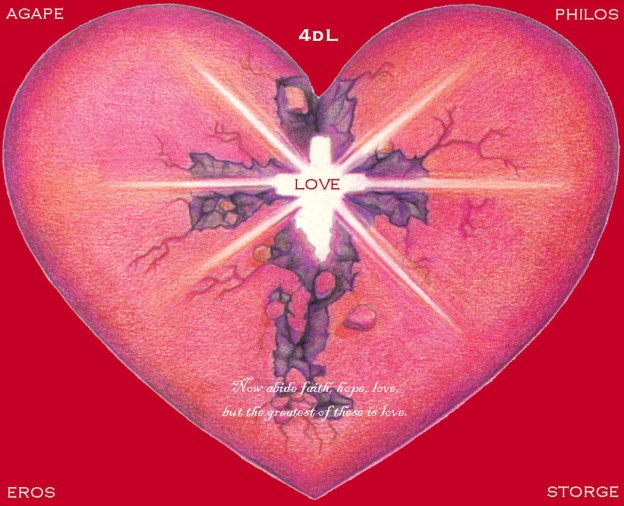
C. S. Lewis understood love as no one else whom I’ve read on the subject. At first this understanding was philosophical and academic. He wrote The Four Loves, an intelligent and insightful book describing the different types of love and their corresponding relationships. Lewis used Greek words to define each love. Agape’ is God’s unconditional gift love, exemplified in Jesus Christ’s sacrificial death on the cross. Philos is the love between family and friends, which the philosopher Plato called “the milk of human kindness.” Eros is erotic or sexual love, designed by God to connect one man and one woman for life. Finally, storge’ is what we would call affection. It is found in each of the previous three loves, expressing itself appropriately in different relationships.

C. S. Lewis lived out his creed. He was unlike like the men of his day, and his perspective is entirely foreign to us today. A breakdown of the timeline of Lewis’s relationship with Joy will reveal this.

Joy was a divorced American author seeking British citizenship when her visa was not renewed. Lewis gave her his name in a civil marriage to provide this. So, Jack, as Lewis was known to his friends,  entered into a relationship with Joy because he wanted to help a friend. This is agape’ love.

A friendship had also grown between Jack and Joy as they discovered common intellectual, literary and personal interests. The friendship deepened as the two pushed through life’s struggles together. This is philos love.

After Joy’s cancer was discovered she was hospitalized. At this point, Lewis realized something he hadn’t previously. He loved this woman as a man loves no other person.  Jack determined to express love to her on another level. He decided to marry her in eyes of the church, and asked a minister of the Anglican communion to perform the ceremony in her hospital room.

Afterward, Jack brought his beloved Joy home and began to care for her in earnest. The cancer went into remission, and the two lived together as man and wife, and enjoyed several years of happiness. It is important to note that the relationship between Joy and Jack did not become romantic or sexual until after the two were married in the eyes of God. This is eros love.

In the end the cancer returned and took Joy from Jack. Lewis had written several notebooks full of personal feelings and observations during this time, and anonymously published them in the book, A Grief Observed. It was a terrible loss for him and the book presents honest observations.

It was friendship and divine compassion (philos and agape’) that drew Jack and Joy together, love that sustained them in her illness, and it was the love of God that strengthened Jack in his grief when Joy was gone.

What is love?  It is indeed a “many splendored thing,” but fundamentally love is genuine compassion for another person. Love is the commitment to act in the best interest of the beloved, regardless of self-interest. Love must be the basis for every human relationship.

So, the next time you choose a friend or a lover, ask yourself:  is this about love, or something else? Then do what is good and right and God-like: choose to love.

Growing Again

I got off track. Okay, that’s a colloquialism, but it’s true. I am a preacher of the Gospel of Jesus, but I got away from my calling to preach Good News. Why? Reasons that I can think of: 1) Disappointment 2) Rejection from people I cared about, 3) Desire for things outside the will of God, 4) Disbelief that God wants to bless me.

Let’s begin with the last first. I’ve tried many things to get God to bless me. Early in my Christian life I made promises that I couldn’t keep. I’ve fasted, both food and other things. I’ve prayed, complained, journaled, read more and more of the Bible, served, given money, offered personal sacrifices. Nothing changes me, and that’s the real issue. I must change, but “a leopard cannot change its spots” and I cannot change my nature.

I’ve come to the realization that what I do and who I am doesn’t matter. It’s who God is that can change, well, everything– even me. That’s the nature of the Gospel. God is good and God loves me (and you) and God has done everything that needs to be done for me (and you) to be blessed and changed. We cannot change our natures, but God will… once we trust his love and goodness enough to permit Him to begin (and continue) that process of transformation.

I was saved many years ago at the age of 16. I made a deal with God that involved nothing more than taking him at his word. I was a lustful, sin sick teenager who heard the message that God loves me and accepts me “just as I am.” I tried to clean up my act, but was not able to measure up. I couldn’t eradicate the lust of my heart. When I heard the Good News that Jesus died for me just as I am to make of me what he wills, then I accepted the offer of life in place of my living death. So, the deal went like this: Lord, I cannot do this on my own; I cannot stop this lust in my heart. If you accept me as I am and you will help me, then you can have my life.

It’s interesting that even many years later I still default to trying to please God by trying to stop lust and sin as a precondition of his blessing. That’s not the deal I made with God, though; or, I should say, that’s not the deal He made with me (and offers everyone in the Gospel). God is good, apart from Him, I am not.

Don’t try to compare yourself to me, though. You might be tempted to say: “Well, I’m better than you. I’m not doing anything that bad.” You might be surprised to find that that isn’t true. Even if it is, Jesus is the example of what a human being is supposed to be, and I assure you, you’re not that good and moral. Or, you might say: “I’m much worse than you. I’ve done horrible things.” You might be surprised to know that God judges the heart above the action, and even when I’ve done nothing externally wrong, my heart is wicked and yearns for things that, even if the world accepts, God hates. So, I may have imagined it but never done it, and you have done it. The difference is whom you’ve hurt in addition to God and yourself, but we’ve both sinned.

The point is: God is good no matter what we’ve done, and he offers to make us right. First, he sees us as good and right, even though we aren’t, because Jesus became our sin and died in our place, debt paid, penalty served. Theologians call this justification or imputed righteousness. What it means is, because of Jesus God sees us as righteous, even while we are still struggling with sin. There are many places where this is taught in the New Testament. For example:

since all have sinned and fall short of the glory of God; they are now justified by his grace as a gift, through the redemption that is in Christ Jesus,” (Romans 3:23–24, NRSV)

For our sake he made him to be sin who knew no sin, so that in him we might become the righteousness of God.” (2 Corinthians 5:21, NRSV)

This is the basis of the Good News, the Gospel. Yet, although I’ve preached it every week, I still fell short of consistently living like I believed it. Why? Well, I said I had an issue believing that God wants to bless me. That resulted from a guilty conscience as I wrestled with lust and anger and other sin. Formulated into a statement, it would be: How can God love someone who desires this, or who has done that?

It goes deeper, though…

Are you ready for the real confession? I’ve always had a suspicion that God doesn’t really love me. Yes, “God so loved the world,” and I’m part of the world of people he loves. But that seems so general and impersonal. God loves everybody. I’m not disparaging that; I appreciate it. However, it didn’t translate into me feeling God cares about me personally. So, yes, I’ll get into heaven because of Jesus, for God loves the mass of humanity so much that he came and died. But what about “he died for me”? I believe God loves people; I just don’t think he really likes me all that much. Sometimes it feels like he doesn’t want to be around me. So, I feel neglected, sometimes abandoned, even though I’m saved.

I default to that because when we consider God in the natural, we are inclined to understand him to be like our human fathers. My biological father was absent; my step-father was distant. I wanted my step-dad to adopt me, but he wasn’t willing to ask me to take his name. I experienced rejection from both men. Additionally, I could never measure up to my step-father. He was a big man, bigger than life sometimes. I was a scared boy. He tried to help me. We studied karate’ together. He certainly didn’t need this; he did it for me. So, don’t think he was a bad guy; he wasn’t. I’m not disrespecting the man. However, I could never call him “Dad”. I always called him by his first name instead. I could call him my dad to other people, but never to his face. Why? He didn’t ever give me permission to.  Almost no one knows this, but when I was baptized as a teenager, I used my step-dad’s last name. I was looking for a Dad when I came to Jesus. And I found one in God the Father, but I have had a hard time sensing or receiving his love and acceptance.

In the natural I feel rejected, neglected, abandoned, unworthy of affection and incapable of measuring up, even at my age… That is how I’m inclined to feel about God the Father.  As a result, even though my thinking and theology teaches otherwise, I have a proclivity to act like I’m on my own living for God doing ministry for Him. Yes, I’m saved, and yes I’ve got some gifts the Lord has given, but I often feel I have to do it all myself.  This is the reason I’ve become so angry when things don’t work, or situations don’t work out, or when people have abandoned or opposed me.  I just feel like there is no one in my corner to to help me up or fight for me when I’m down. This has created a negative environment at times. And it does not indicate that I have the right quality of faith in the God of Jesus Christ.

However, that has not consistently been the case, and it has begun again to change. God is a good, loving and engaged Heavenly Father and the One whom Jesus gives me the right to call “Daddy.” I’ve begun to sense that once again as I’ve simply chosen to believe it in spite of my own sin.

Last year I began with a fast of several things; in fact, I encouraged our church to do the same. I continued saying “no” to one of these things for many weeks. This didn’t stop my lust, anger and other assorted attitudinal sins, though: only faith has helped.

These have indeed an appearance of wisdom in promoting self-imposed piety, humility, and severe treatment of the body, but they are of no value in checking self-indulgence.” (Colossians 2:23, NRSV)

The year was not one of growth, at least not on the surface. However, what I began to realize and internalize more deeply than ever is this: God loves me anyway. I’m not saying I believe he loves me and doesn’t care if I become angry or lustful. I’m saying, he loves me in spite of my sin and loves me enough to stay with me and work with me and help me overcome. That is a very big deal.

I’ve known and taught, nearly my whole ministry, that our lives must be God-centered rather than self-centered. Early on, I was profoundly affected by the book Pursuit of God by A.W. Tozer. I came to the conclusion that our greatest problem is self-centeredness, and that our greatest pursuit must be God himself, living a God-Centered life.

However, in reading this confession you can detect a lot of self orientation. That’s because knowing something, even teaching it, is not the same as realizing and living by it. That is what has begun to change over the last 6-12 months. Through the typical disappointments and failures, my faith has– are you ready for this?– grown stronger. This has not been the result of me overcoming my weaknesses, but of realizing God’s acceptance of me in the Beloved (in Jesus) IN SPITE OF MY FOOLISHNESS AND SIN.

The covenant I entered with God is the New Covenant, and it is not offered to those who are deserving, good and moral, but to those who recognize they are weak and in trouble. This Agreement with God was inked in blood, but not mine. Jesus signed it when he was crucified. I cannot fail because the New Covenant is in Jesus’ blood. He is the Guarantor. Not me. My part is to agree, to commit my weak self to Him, to open up and let His Spirit enter and do the lifelong work of transformation. I just need to trust Him, instead of myself. “Trust in the Lord wit all of your heart and do not lean on your own understanding” (Proverbs 3:5). I need to love Him, above myself. “He must increase but I must decrease” (John 3:30).

I fail my Father daily in big and small ways, but Jesus never falls short. His covenant of grace will always remain in place. He will never deny or forsake me. That is the Gospel, and it is very Good News.

What will be the result of this renewed realization? I am okay. I am secure. I am not easily angered or shaken. I will persevere in believing that God will bless and anoint and cause me to succeed in His work. I will not fail. Discouragement, disappointment, anger and doubt are all dissipating, evaporating like the dew when the sun grows warm. Hallelujah!

I am positive of this. It is not self-assurance or delusion, but faith.

“Now faith is the assurance of things hoped for, the conviction of things not seen” (Hebrews 11:1).

I am convinced. Faith is inherently positive, so I am positive. This will be a challenge in a darkening world filled with bad news, increasingly opposed to Christian faith. However, I am not afraid. I will not shrink back to destruction, but I will persevere in faith to the preserving of my soul in paradise and life eternal (Hebrews 10:39).

No, in all these things we are more than conquerors through him who loved us. For I am convinced that neither death, nor life, nor angels, nor rulers, nor things present, nor things to come, nor powers, nor height, nor depth, nor anything else in all creation, will be able to separate us from the love of God in Christ Jesus our Lord.” (Romans 8:37–39, NRSV)

Amen.

Mithra vs. Christ

From a published interview with historian Edwin Yamauchi.

“Nothing in Christianity is original” (DaVinci Code, Dan Brown).

Writers have claimed that a pagan mystery cult Mithraism is really the basis for Christianity. Actually, this is only one of several mystery cults that popular writers have associated with Christianity. Others are: Attis, Osiris, Adonis and Dionysus. However, the Persian god Mithras who was worshiped in the mystery cult called Mithraism is the closest parallel.

“Mithras… was born of a virgin in a cave on December 25, was considered a great traveling teacher, had 12 disciples, promised his followers immortality, sacrificed himself for world peace, was buried in a tomb and rose again three days later, instituted a eucharist or “Lord’s Supper,” and was considered the Logos, redeemer, Messiah, and “the way, the truth, and the life.”

How do you respond when people  present ancient “facts” like this?

What do you do once you’ve been told something like this?

Mithraism as a mystery religion cannot be attested before about AD 90.

“Gordon dates the establishment of the Mithraic mysteries to the reign of Hadrian, which  was AD 117-138.

Mithras was born of a virgin… No,the legend has it that Mithra was born out of a rock.

Mithras was born in a cave like Jesus…The New Testament doesn’t say Jesus born in a cave.

Mithras was born on December 25… Jesus was actually born in the Spring (Lk. 2:8).

December 25 was the date chosen by Emperor Aurelian for the dedication of his temple to Sol Invictus, the Roman god called “the unconquerable sun.” Mithras is sometimes depicted shaking hands with this god. It became the date Christ’s birth was celebrated in AD 336, the year before Constantine’s death, following the Christian practice of appropriating pagan holidays for holy use.

Mithras was a teacher with 12 disciples…. No, Mithras was a god.

Mithras’s followers promised immortality…. Inferred, but what’s new? That’s religion.

Mithras sacrificed himself…. He did not. He killed a bull.

Mithras buried and raised…. We know nothing about Mithras death, so there could be no resurrection.

Mithras was considered “Good Shepherd, Way, Truth and Life, Logos, Redeemer, Savior. “No… that’s reading Christian theology into this” Yamauchi

Mithras had a Eucharist meal…. Common meals shared in most religious groups.

Was a Mithraic rite called taurobolium the basis for Christian belief in Christ’s blood sacrifice for sins?

Taurobolium- initiate was placed in a pit with a grate over it and a bull was slaughtered above allowing the blood to baptize him.

It is an anachronism to base Christ’s sacrifice on the practice, since it is first attested to in the Attis cult in AD 160.

“Do you see any evidence that Christianity borrowed any of its beliefs from Mithraism?”

“Not really… they were rivals in the second century and later.”

So, my friends, not everything is as it appears on the internet!

Winter Solstice

Each day there is less light,

Spreading darkness threatens

To bring unending night.

Will the world be mantled in black?

Will light be pushed back

Until it ends?

Will there come a day,

When there is no day?

The sun is a pawn,

Even if its gravity holds us

And its light uphold us,

It is nothing but a ball of gas,

A created thing

Subject to the laws of the Creator-King.

Today is Solstice,

Let the celebration begin, 

the Light of the World has come!

Son of God, the only One.

Paradoxes abound: 

immortality became mortal;

Infinity limited itself;

Almighty God became human.

Creator of 200 billion trillion stars

Born as a baby on a small planet

Orbiting a seemingly insignificant sun.

The shortest day is here!

Darkness must end.

The light has won.