Category Archives: Uncategorized

Sunday Morning Coming Down

On a Sunday morning sidewalk
I’m wishing Lord that I was stoned
‘Cause there’s something in a Sunday
That makes a body feel alone.
And there’s nothin’ short of dyin’
That’s half as lonesome as the sound
Of a sleepin’ city sidewalk
And Sunday mornin’ comin’ down.
-Johnny Cash

There’s been a good bit of discussion recently about the value of attending church. Author Don Miller upset a few, but may have pleased even more people when he wrote in his blog that he doesn’t connect with God very well when he goes to church. He went further to reveal that about five years prior to his blog post he stopped attending church regularly. What might be surprising to you is assertion by Miller that quite a few Christian leaders with whom he interacts (para Church leaders I’m assuming) don’t attend church either. There’s also a book that just came out to reinforce this approach to Christianity.

As some of you may be aware, the church that I lead has been doing an experiment this summer. Basically we cancelled Sunday morning worship and asked people to reach out instead. We have scheduled a 5:30 PM worship time for people to gather instead. This is risky, but by no means extreme. We’ve called it The UnChurch Experiment, and it has brought some new people into our community, but our worship attendance hasn’t gone up as the result. Hopefully, our people are at least enjoying sleeping in on Sunday!

Initially this experiment was disorienting for me. I’ve been going to church on Sunday morning, or teaching people during that time period for the great majority of my life. Early on I didn’t like it. I do like worship on Sunday evening, so that’s not the issue. It’s just, well, Sunday morning is when you’re supposed to go to church. Right? It’s the time the majority of people who attend church do so, so it must be the right time for it. Sunday morning is the time when Jesus rose. Well, if you go to a sunrise service every week you might be closer to commemorating Jesus’ first appearances to Mary Magdalene and the other women. Interestingly, the first community gathering with Jesus was on Sunday evening (check John 20:9 and Luke 24:29-36).

This is the seventh week of our experiment and what I’ve discovered about not attending church on Sunday morning is, well, how easy it has been not to be in church. I wrote on the first week about how I felt like I was going through withdrawals by not attending. No more. In fact, although I feel like I’m missing something at times, I don’t miss it enough to regularly attend church anywhere else as the result. I’m sure you wouldn’t expect the pastor of one church to attend another on Sunday morning, and this is doubly true since we’re all supposed to be reaching out and all. Yet here I am, sitting in the front of an empty church writing this during the sacred eleven o’clock worship hour, and not feeling any loss any longer.

Perhaps this is one of the things God wants to teach me through all of this. He may want me to identify with many of you who don’t attend church regularly. Believe me, I understand the tendency to want to stay home or do something else. However, there are repercussions, consequences, especially if you don’t have a consistent walk with God. By the latter I mean you practice your Christianity: you pray regularly, read your Bible and try to hear a message from God regularly, give your time and money to help people in need, share Jesus and his love as often as you are able, obey Jesus’ teaching. Even if you’re actually doing all of that you will fall short and fail to grow and become more like Jesus you are not involved and accountable to a community of people who worship together in spirit and truth: that’s a church.

Jesus established the church much in the same way as the Father established family at the beginning. These are basic support networks for people. We need family. We need community. God works and speaks through other people. God created these social structures to cultivate and nurture people as they live and grow in the world. So, even though I don’t relish the thought of going to church a listening to another preacher talk, or watch the show that some churches put on for Sunday morning, I need church. I need the people, the accountability, the opportunity to exercise my gifts, a place to call home.

I’m looking forward to worshiping with our community this evening, and I’m looking forward to restoring our Sunday morning worship too. Hopefully we’ll be able to keep both of these times!

“In the park I saw a daddy
With a laughin’ little girl who he was swingin’
And I stopped beside a Sunday school
And listened to the songs they were singin’
Then I headed down the street
And somewhere far away a lonely bell was ringin’
And it echoed thru the canyon
Like the disappearing dreams of yesterday.”
From: Sunday Morning Coming Down
by Johnny Cash


Wave After Wave

Image

Wave after wave after wave of
never ending water washing up
on the shore and washing away
my pretty little sandcastles.

No matter what I do I cannot stop
the water.
More sand, even a wall of it,
will not keep the waves away.

In my dreams I hear them,
incessant susurration
of the ocean assault
on my Normandy beach.

I am weary of trying,
and praying and crying,
my throat is hoarse, eyes are dry,
and I’m so close to dying.

The night comes and I fall
asleep,
but then I awaken
to a new day.

I’ll try again
to hope, to believe
to live, to love
to die another day.

Maranatha!
How long, how long?
Son of God, come.

The UnChurch Experiment

Image

Lifewellchurch.com will be doing something different for the summer. Perhaps you can incorporate this challenge into your own church experience, or apply it in some way to your walk with God.

Beginning June 1st we will not meet on Sunday morning…   for the rest of the summer! 

Do not to go to church anywhere Sunday morning; instead, be the church to the unchurched by shining your light where the unchurched go. 

We will gather together each Sunday at 5:00 p.m. to hear your stories, then we’ll worship our God in Spirit and Truth at 5:30.

10 UnChurch Experiment Assignments.

1. Invite some unchurched friends and/or family to brunch, ask if you may pray for their needs. 
2. Go somewhere fun and find an unchurched person to check out Lifewell UnChurch Worship
3. Do a service project with your friends and/or family. 
4. Relax and relate with your family: no electronic devices or TV, just face to face contact. 
5. Read your Bible for one hour without interruption, then post to a social network about what you learned. Invite people on your network to Lifewell UnChurch Worship.
6. Knock on a neighbor’s door and share something with them. Invite them to check out Lifewell UnChurch Worship.
7. Make a video to share the Gospel, i.e., interview some people about a relevant topic that may be used as a catalyst for sharing the Gospel. Tell them it will be played at a Lifewell gathering.
8. Walk or ride bikes at a park near your house and meet others. Invite them to Lifewell UnChurch Worship.
9. Walk the ROC neighborhood (an older and poorer area of town densely populated with apartments) and invite people to Lifewell UnChurch Worship at 5:30p.m.
10. Volunteer somewhere. Shine your light and tell everyone about Jesus. Invite people to Lifewell UnChurch Worship.

Strong Support for Separation of Church and State

I agree with the separation of church and state, and that includes the separation of religion from government. I am not an atheist. I am a follower of Jesus Christ and his teaching. Moreover, I am the pastor of a Bible teaching church. I support the free exercise of religion and speech. I support every person’s right to freely choose belief or disbelief. I think this way because it is evident that the Creator of human beings highly prizes free choice.

The narrative of creation for Christians and Jews, fundamentally agreed upon by Muslims, is found in Genesis chapters one through three. It is there that we find human beings are created in God’s image (1:27). God is a person with a free will. God does everything after the counsel of his own will (Ephesians 1:11). He has no needs. He cannot be coerced. This Creator made everything, simply because he chose to do so.

God’s motive for creating people is love. That is his nature: “God is love” (1st John 4:8). Love is not an emotion; it is not a need for attention, affection or acceptance. At its essence love is the determination to care and do what is best for the beloved. God created other persons to be his beloved. He did this because he wanted to share his love. It is also his desire to receive love from people.

Love compels, but it cannot be compelled. Coercion destroys love. Forced affection is abusive; it is molestation, not love. Therefore, freedom of choice is essential for love to be shared.

In the Bible’s account of beginnings there is a critical choice for the first man and woman. Two clear options are presented: live in communion with the Creator and enjoy the fruit of his garden paradise, or eat the forbidden fruit and die. Death was a curse that involved being severed from fellowship with the Author of Life, which eventually resulted in physical death. Adam and Eve chose the forbidden fruit and were banned from the Garden of Eden. They traded God’s blessing for his curse. This is called the Fall. It was their choice.

Every person who is born is given the same choice. The difference is, human beings are born into a fallen world filled with the effects of estrangement from their Creator. Nevertheless, God is still seeking lovers. Christians believe God demonstrated his love in this, even while we continue in sin, Jesus Christ, the unique Son of God chose to die on the cross prove His love for everyone (Romans 5:8). We also believe Christ rose in victory over the curse of death. It is every person’s choice to receive God’s love and return it in worship, or to disbelieve and reject it. Freedom of choice is absolutely essential.

You do not have to agree with Christian beliefs to benefit from them. In fact, the United States of America was founded upon the belief in a Creator who has given every person the right to choose. The Declaration of Independence clearly states this. “We hold these truths to be self-evident, that all men are created equal and are endowed by their creator with certain unalienable rights. That among these are life, liberty and the pursuit of happiness.”

The First Amendment to the United States Constitution, prohibits the establishment of religion, and ensures everyone the freedom of speech and religion. “Congress shall make no law respecting an establishment of religion, or prohibiting the free exercise thereof; or abridging the freedom of speech, or of the press; of the right of the people to peaceably assemble…”

This amendment was established due to the concern on the part of the founders that a state church, such as the Church of England, would promote precisely the kind of intolerance the Pilgrims had escaped. Although the overwhelming majority of people in the 13 Colonies were Christians, they had different ways of worshiping and disagreed in various points of doctrine. The First Amendment gave them, and gives us, freedom to worship, and to speak freely about religion.

Today, each side of the political spectrum promotes a different an interpretation or application of the First Amendment. Those on the right support Christian symbols and Christian prayers in government and schools because they believe our nation is founded upon Christian principles, and that this practice does not prohibit other religious expressions. Those on the left oppose public displays of religion, but many seem particularly averse to Christianity. They hold this position because they believe any instance of government supporting a particular religious expression or practice, even when clearly historical in nature, results in some sort of tacit or de-facto establishment. They are opposed to Christianity because it has been the dominant religious expression in our nation.

So, do we eliminate all religious references from government and schools? Or do we allow a community to decide what should be permitted? What if we offer equal opportunity for different religions to pray or display their symbols? This would seem to offer an equitable
solution because it avoids offering preferential treatment to any one religious group.

The last solution was applied by the city council of the town of Greece, New York, which the Supreme Court recently ruled has the right to continue praying before their meetings. The accusation had been made that the city council favored Christian prayers, and, by virtue of this, encouraged the establishment of Christianity. In order to pacify the complaints and prove that they weren’t opposed to equal opportunity, Greece had brought in other religious leaders to pray, including a Wiccan priestess. However, it is not always reflective of the values of a community.

The majority of the Supreme Court supported the rights of the City Council to open in prayer.“Ceremonial prayer is but a recognition that, since this Nation was founded and until the present day, many Americans deem that their own existence must be understood by precepts far beyond the authority of government,” wrote Justice Anthony M. Kennedy.

However, if government supports one religious group, it is obligated to support all, even fringe groups, even religions that would oppose law and order. Satanists have created a large goat-headed statue to stand alongside the 10 Commandments outside the Oklahoma City courthouse,. A compelling argument could be made that Satan has historically been associated with rebellion and opposition to law and order. In fact, Satan represents evil. What makes the proposed monument even more disturbing is the inclusion of two children, one standing on either side of the figure, kissing its hands. I’d rather see the 10 Commandments removed from the courthouse than to legitimize Satanism.

Many Christians believe they should support the display of religious symbols in government, and prayer in public schools. In fact, there has been a tendency for Christian pundits and preachers to insist that the removal of public prayer from schools is precisely what has cause a moral decline. I disagree. Formal prayers in public schools do not necessitate the morality of those who are constrained to listen to them. Display of the 10 Commandments at the courthouse does not mean people must or will follow them.

You may think I have a liberal opinion at odds with traditional Christianity, but that would be incorrect. Baptists have historically supported the separation of church and state very strongly, and that continues. In the Supreme Court case we looked at above, the Baptist Joint Committee for Religious Liberty filed a friend-of-the-court brief supporting the plaintiffs. That is, they opposed prayer in the City Council. I concur.

If the examples of the Wiccan Priestess praying to pagan gods, and the Satanists seeking to erect their hideous statue don’t serve to support separation, then let me conclude with this.
Everyone has the right to believe and express their religion. Everyone should have the right to present their ideas in the marketplace. Government has no right to oppose any religion, nor the right to support any religion. I am content to preach the Gospel of Jesus Christ and allow people the freedom to decide for themselves without government intrusion.

I don’t want a Mormon teacher proselytizing children from my church. I don’t want a Muslim legislator seeking to establish Sharia Law in my community or in this country. I will not bow my head and listen to a Wiccan priest/priestess pray to a false god. I have this right and no government should require me to do so. I do not believe that a Christian official has the right to force atheists, Jews or those from other religions to bow when they pray either. This nation values freedom. The God whom I serve strongly supports everyone’s freedom to receive or reject his Son. In the end God will judge: not you, not me, not the Supreme Court, not the United States government. Until Judgment Day, let each person decide for herself, for himself, what to believe, in whom to believe, and what to do about that. I will proclaim the Gospel of Jesus until that day, and I will support your freedom to receive or reject that message.

Non-conformist Christianity

Image

Christianity in the West has, for quite some time, been about cultural conformity, and very little, if at all, about the life and teachings of Jesus. It used to be that growing up in the United States meant you were exposed to Christian values, even if you chose to ignore or rebel against them. Not so today. To conform with Western culture, more specifically the American version, is to be at odds with the values of Christ. Therefore, in order to be a Christian, the kind of Christian that lives according to values taught by the biblical Jesus, you will need to become a non-conformist.

There are still vestiges of Christian culture, and plenty of people who appreciate it— even if they don’t really live by following Jesus— so, you’ll have a few friends. However, genuinely following Jesus Christ’s teaching will put you at odds with the majority. Your lifestyle will appear strange, and many of your choices will alienate you, even from church people. This is okay… if you believe what Jesus said.

If the world hates you, you know that it has hated Me before it hated you. If you were of the world, the world would love its own; but because you are not of the world, but I chose you out of the world, because of this the world hates you” (John 15:18-19, ESV).

Don’t assume that “the world” in Jesus’ statement refers only to secular culture. It includes the church and its culture too. Remember, it was the most religious and well respected people who were the architects of Jesus’ execution. These were the guardians of culture in a society founded on religion. It was they who failed to recognize that God had come to visit. They confused their system of ritual, liturgy and law with God. The Romans worshiped strength and their own power. These first century Jewish leaders actually worshiped their own religious power. Jesus threatened that; he made them jealous; they had him killed.

In our day I’m no longer surprised when priests and ministers are exposed as frauds or moral failures. There are too many who are in religious leadership for the wrong reasons. I would be more surprised if every high profile leader or celebrity pastor were actually as pure as they pretend to be. Freud had at least one thing right, there exist ego defense mechanisms employed by people to protect their public personae. Among these defense mechanisms, Sigmund identified what he called “reaction formation,” wherein a person comes out publicly against something that they are actually practicing (or at least are harboring).

An example of this may be observed in the 1999 movie American Beauty. Ricky is the son of a homophobe. Ricky becomes friends with his next door neighbor Jane. Jane’s father is Lester (played by Kevin Spacey), who has a crush on one of Jane’s female friends. One day Ricky’s homophobic father comes on to Lester. After Lester rebuffs the surprising sexual advance, Ricky’s father shoots and kills Lester. The idea, I believe, is not that the man hated Lester, but he was driven by shame to kill what he hated about himself. Reaction formation is what is behind the shooter’s public hatred of homosexuals. One wonders about the late Fred Phelps of Westboro Baptist Church…

People are attracted to money, sex and power. When religion offers a way to obtain any of the three, there will those who pursue it for that reason rather than the purported spiritual purpose. So, the answer to non-conformity with the world is not conformity to a religion, denomination,or church’s cultural expectations. In fact, the conservative expressions of church in the U.S.A. may be little more than the conservation of an older iteration of American culture, which may have some values that derive from the teachings of Jesus, but some that do not.

We seem to have selective memory when it comes to our longing for a bygone era. Peruse the fiction aisles of a Christian bookstore and you’ll encounter many novels which are set in the pioneer days. This seems to be a golden era in the minds of conservative Christians. The women all have long dresses and bonnets on their heads, the men are strong, family oriented and honorable. However, an honest examination of history would find many non-Christian values and religious expressions, during this time period. Then there’s slavery and racism. The pictures on the covers of these books are of white people. People of color probably do not look back at the 1800’s with nostalgic longing.

It doesn’t matter if you attend church or fancy yourself an atheist, you cannot escape the influence of culture. Those of us who seek to follow Jesus, however, need to stage a rebellion. I’m not thinking about a new monastic movement, or withdrawing from society like the Amish. We need to change our thinking and change our ways. We need to eschew conformity to either the secular or religious cultures and have our minds renewed by the truth of God. We need awakening. We need transformation. We need a resurrection.

This all begins with dissatisfaction. If think you’re all you need to be, if you have all you want, then you’ll never change. Jesus said he came to cure those who are sick, not affirm those who think they’re well (Matthew 9:12-13). He is the light of the world, but those who think they see, never will. “The god of this world has blinded the minds of the unbelieving, so that they might not see the light of the gospel of the glory of Christ, who is the image of God” (2 Corinthians 4:4).

Dissatisfaction with the world system, with our culture, may then lead us to a willingness to look elsewhere for happiness and fulfillment. “We walk by faith and not by sight” (2 Corinthians 5:7), so the ability to look elsewhere requires faith. Believe in the existence of a loving, almighty Creator. Trust him. Seek God by looking to the one who claimed to be his only born son. Jesus is “the radiance of God’s glory, the exact representation of his nature” (Hebrews 1:3). No one has ever seen God, but Jesus has explained Him (John 1:18). He is the image of the invisible God” (Colossians 1:15), and “in him all the fullness of God lives bodily” (Colossians 2:9). Jesus boldly proclaimed, “He who has seen me has seen the Father” (John 14:9). If you want to know the truth and be free, then follow Jesus Christ and his teaching (John 8:31-32).

Our churches must become communities of non-conformity by virtue of taking the teachings of Jesus seriously and doing what the Lord commanded. Our lives must be consumed with love for God, rather than love of money. We must love one another the way Jesus loved us, rather than loving ourselves and seeking our own agendas. We must love our neighbors as ourselves, instead of loving stuff and envying those neighbors who have more than us. We must learn to be sacrificial servants, rather than self-seeking and self-serving consumers.

We must learn to worship and enjoy God’s presence in our everyday activities instead of constantly seeking to be entertained. We must reign in our insatiable and increasingly perverse sexual appetites. Pornography, fornication, adultery and homosexuality, all of which are practiced widely (even in churches), must immediately and completely stop in the lives of Christ’s followers. The love of guns, love of violence, bloodlust, all must become abhorrent to us. Guns are tools. I don’t love my shovel, my crescent wrench, or my blender.

We need to stop depending upon chemicals to make us happy or keep our moods positive. Alcohol, marijuana, antidepressants, energy drinks, cocaine or meth: it doesn’t matter, if I’m relying on the chemical instead of God, then it’s an idol and it has to go. “All things are lawful for me, but not all things are profitable. All things are lawful for me, but I will not be mastered by anything” (1 Corinthians 6:12); “all things are lawful, but not all things are helpful. All things are lawful, but not all things build up” (1 Corinthians 10:23).

If this is going to happen it will require a death. The death is the old me, my old self. That will not happen, indeed it cannot, through my own efforts. I don’t have the desire or courage to begin the process. Self-denial, self-discipline and harsh treatment of my body won’t change me on the inside. Faith in the crucified and resurrected Jesus, however, will. “For I have been crucified with Christ and no longer do I live, but Christ lives in me. The life I live in the body I live by faith in the Son of God, who loved me and gave himself for me” (Galatians 2:20).

I don’t think a non-conforming community of Jesus should avoid the world or avoid the culture, though. We need to engage people who are enthralled with culture and inured to religion with a real and relevant and renewed counter-culture centered on Jesus and his teachings. I’m not sure how all this looks yet, but I’m seeking and getting a sense of how it feels. Anyone else interested in joining the non-conformist revolution? Start with a serious reading of Jesus teaching to his followers about what it means to live out life like a follower. You’ll find it in Matthew chapters five, six and seven.

Selfie Nation

Incessant selfie society,
sick to our self-absorbed souls,
mired in a miasma of mirrors
and cameras carried everywhere
to capture every pointless moment
of our tiny little lives.
Christ commanded denial of self,
but our faith’s in Easy Jesus,
not the crucified risen One.
We really believe in self-love,
self-service not self-sacrifice.
I worship me, not Thee.
Do not rest assured,
Christ is coming.
When he arrives he will unsettle
the smug hubris of selfie nation
with a fire too hot to stand,
unless you’re with the Fourth Man.

Fasting for Lent and Beyond

Image

The season of Lent is a time many Christians choose to fast. The following are some reasons for fasting, and not just for Lent. Fasting may be beneficial at any time.


1. Fast as an Act of Dedication–  Jesus went into the wilderness and fasted after his baptism and prior to entering into his ministry. Perhaps he did this to gain confirmation and clarity by intensely focusing on God.


 2. Fast as an Exercise of Discipline–  Learn to say no to “me.” All of the temptations were for Jesus to act expediently and egotistically. If Jesus had given in it would not have been an exercise of faith, but, rather, the wildly alternating swings between self-doubt and presumption.


3. Fast as an Affirmation of Dependence–  Learn to rely on the power of God. Jesus’ first statement in response to Satan’s temptation. “Man shall not live on bread alone, but on every word that proceeds from the mouth of God” (Deuteronomy 8:3 as quoted in Matthew 4:4, also John 4:34).


4. Fast to Establish Determination–  Learn to have a tenacious and unshakeable faith. “This kind can only come out by prayer and fasting” (Mark 9:29, Matthew 17:21).


5. Fast as an Act of Desperation–  Cry out to God in repentance (Joel & Israel, Jonah and Ninevah). “Even now,” declares the Lord, “return to me with all your heart, with fasting and weeping and mourning.” (Joel 2:12 NIV). A need to hear from God at all costs (Daniel 10 & 21 days of prayer), David seeking the healing of his 1st child by Bathsheba. 


In 2014 Lent begins on Wednesday, March 5th (Ash Wednesday) and extends until Easter Sunday, April 20th. 

Whatever you decide to do, remember the following principles. 

If you make a vow, keep it.  

Choose something that will really require discipline to give up. 

Giving up what you shouldn’t be doing to begin with is not fasting, it’s obedience.


 Here is what Pastor D is challenging Lifewell Church  to consider.


1) Pick a legitimate pleasurable food or activity and wait until Easter Sunday to enjoy it.

Why? You are learning to discipline yourself for the sake of Christ. You are learning that life is not about pleasure and consumption.

Examples: stop eating candy or dessert, stop drinking soda, coffee or alcohol, stop watching TV,  watching or listening to sports, secular music,  talk radio, movies, stop playing video games, get off of Facebook or another social media app, stop texting.


2) Fast every Friday from 6am until 6pm through Easter weekend.

Why? You are fasting to remind yourself of  Jesus’ suffering on Good Friday.

If you are unable to fast completely, drink juice during this time. For health purposes drink pure fruit or vegetable juice (not artificially sweetened).


3) Eat no flesh. Abstain from eating meat until Easter Sunday.

Why? You are abstaining from literal flesh as a reminder to reckon yourself dead to your fleshly nature. More importantly, remind yourself that you are alive in the Spirit through Christ’s resurrection form the dead. Remember, only faith brings the realization that you are united with Christ in his death and resurrection. Fasting will not do this apart from faith.

If you participate, I believe you will grow from the experience.

Son of God Movie Review

Image

I’ve watched the majority of Jesus flicks, including The Passion of the Christ (2004, stunning film), The Last Temptation of Christ (1988, disturbing film), and Jesus of Nazareth (1977, made for TV movie). Initially, I wasn’t all that excited about the current film, but my hopes were elevated in days prior to it’s release. So, I caught a $6.50 discount showing on opening day. This is my review.

If you want a fast edit, here it is. The movie was okay, not bad, but certainly not a great film. If you liked the Bible mini-series that was televised in the Spring of 2013, then you’ll enjoy this. If you are a believer, you’ll likely enjoy some or all of it, and perhaps find yourself emotionally moved. For non-believers there is an inescapable cheese factor that can be off putting. Jesus looks like a rock star from the 70’s or 80’s with male model looks, but bad hair. I could also envision a few sarcastic people laughing or rolling their eyes at some points. I thought it was worth $6.50. However, I probably wouldn’t see it again in the theater unless I brought a guest whom I believed would benefit. I might show some clips at our church one day.

Here is what I appreciated. It is a faith filled film. The major contours of Jesus’ life are followed. He is portrayed as the Son of God, crucified, resurrected and returning. These are the most important issues. That is why I can recommend the movie.

There were a number of factual errors that irritated me. Like the Bible mini-series that birthed it, this film plays fast and loose with the facts. I’m not speaking about debatable issues, but historical details found in the Bible text. For the most part this movie is based on John’s gospel. It includes Nicodemus, the woman caught in adultery, and the resurrection of Lazarus. All of these characters and their stories are found exclusively in the Gospel of John. However, when relating stories found in that gospel, there is a consistent disregard of the facts: events are reordered, truncated and sometimes told inaccurately. Several examples follow (spoiler alert).

In this movie’s version of raising Lazarus, Jesus enters the tomb, breathes on the dead man and speaks part of John 11:25-26, “I am the resurrection and the life.” The Gospel of John records that Jesus actually stood outside the tomb and called, “Lazarus, come out!” at which point the dead man exited still bound in grave clothes. The Lord had assured Lazarus’s older sister Martha “I am the resurrection and the life” prior to his arrival at the tomb. Okay, I can already anticipate that some of you are thinking I’m being overly picky, but if you don’t think that sounds important, hang on, there’s more.

In the movie, when Jesus first appears to the disciples, he is glowing white. Thomas won’t look at him. In fact, the doubting disciple looks down and says something like, “I don’t believe it.” Jesus goes around and touches each disciple on the head, when he touches Thomas, the doubter believes. This isn’t even close to what John’s Gospel records. In fact, it seemed silly to me that Thomas looked down and said he didn’t believe when there is a brilliant white figure standing about eight feet away lighting up the room. In the Gospel of John, Thomas was absent on the first Sunday evening when Jesus appeared. He’s often called Doubting Thomas because he said he would need to see and put his finger in the nail prints and put his hand into Jesus’ spear pierced side before he would believe. When Jesus appeared the next Sunday Thomas was present and made the greatest confession of Christ found in the Bible. Thomas called Jesus “My Lord and my God!”

The movie is called Son of God. What’s wrong with portraying the event as it happened? I’ve made a feature length film, and a number of shorts. I understand that the filmmakers wanted to truncate Thomas’s two appearances and just communicate that his doubt was alleviated, but what they did doesn’t work, doesn’t seem authentic, isn’t accurate, and misses a perfect opportunity to reinforce the main idea: Jesus is the Son of God.

Why am I so hung up on this issue of details? The filmmakers aren’t dealing with a novel or a comic book here. They’re seeking to portray God’s Word. This is history, holy history. It is the most important life ever lived, the most important event that ever occurred. We have accurate, inspired records of Jesus’ life. What really happened is really important. Let me give two final examples.

First, there was an error that is also found in the film The Passion of the Christ. While the soldiers are crucifying Jesus, they tear his tunic in half. The historical reality is, the soldiers were careful not to tear Jesus’ tunic because it was woven in one piece and therefore valuable. They gambled for it instead. Why is this detail important? It fulfilled a Messianic prophecy found in the Old Testament, which John’s gospel carefully points out (John 19:24). The movie does show the soldiers shooting dice at the foot of the cross, but we are left to wonder why.

Secondly, the holes in Jesus’ hands after the resurrection are so large they seem cartoonish. They are the size of silver dollars. Other than the fact that this appears unrealistic, it is also clear that if the nails had made large holes like this it would have caused broken bones in each of Jesus’ hands. The Gospel of John points out another important Messianic prophecy that was fulfilled at the cross. The Roman soldiers did not break Jesus’ legs to expedite his death as they did with the other two crucified criminals. Instead they pierced his side with a spear to verify that he was already dead. John’s gospel tells us this fulfilled the prophecy that stated, ”Not a bone of his will be broken” (19:36). Jesus was crucified on the day Passover lambs were slaughtered, and the Jews were forbidden from breaking any bones in the lamb. Jesus is our Passover lamb! Many times details really do matter. Facts always do.

So, by all means, go see the movie Son of God. However, get the facts straight by reading your Bible. I am concerned that many people will not. If you are a believer, then use this film to tell people about Jesus. Invite them to a church that teaches the Bible and proclaims the Gospel of the crucified, risen, returning Savior of the world.

What Is Love?

What is love? Valentine’s Day makes this a pertinent question.  My favorite writer on the subject didn’t get married until he was 58, and even then it was for charitable, not romantic, reasons. 

C. S. Lewis married Joy Gresham in a government office to provide her with British citizenship.  A few months later Joy was diagnosed with cancer, and her condition deteriorated rapidly.  Jack, as Lewis was known by his friends, chose to love and care for Joy.  The feeling between them grew, and nearly a year after the marriage of convenience there was a hospital wedding presided over by a clergyman from the Church of England.  “Till death do we part” was a potent reality.  Joy left the hospital to convalesce.  It was not until this point that she moved in with Jack.  God worked and Joy’s cancer went into remission.  Jack and Joy lived happily for three more years, until the cancer returned and she died.  Jack wept.

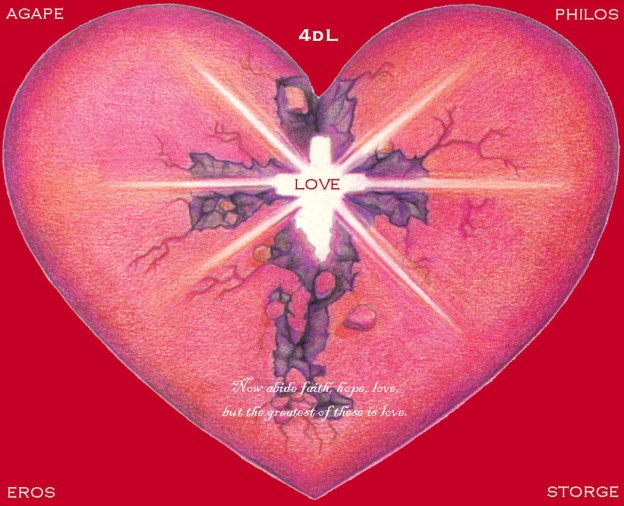
C. S. Lewis understood love as no one else whom I’ve read on the subject.  At first this understanding was philosophical and academic.  He wrote The Four Loves, a magnificent work describing the different types of love and their corresponding relationships.  Lewis used Greek words to define each love.  “Agape’ “ is God’s unconditional gift love, exemplified in Christ’s sacrificial death on the cross.  “Philos” is the love between family and friends, called “the milk of human kindness” by Plato.  “Eros” is erotic or sexual love, designed by God to exist between one man and one woman for life.  Finally, “storge’ “ is what we would call “affection”.  It is found in each of the previous three loves, expressing itself appropriately in different relationships.

Lewis’s relationship with Joy demonstrated the truth of his philosophical approach to love. Follow the progression through these Four Loves. Lewis began by showing Joy Gresham God’s kind of love (agape’). His actions were not based on passion or feeling. His decision to marry was something he did for her benefit, not his own. When she became sicker, Lewis continued to show compassion by helping her. The friendship (philos) between Jack and Joy deepened, affection grew (storge’), feelings became stronger. Even though Joy was at the point of death, Jack wanted to marry her “in the eyes of God.” They had arrived at a point in their relationship where they wanted nothing and no one else but each other (eros). They lived together as man and wife and presumably enjoyed intimacy until Joy died.

What is love?  It is indeed a “many splendored thing,” but fundamentally love is a genuine concern for another person.  Love is the commitment to act in the best interest of the beloved, regardless of self-interest.  So, the next time you are attracted to someone, ask yourself:  is this really love?  Then don’t act on the basis of your desire or feeling.  Do what is right, and what is best, for the one you love.

Give Them Space and Time

Image

People need space, time to make their own decisions. God grants each of us freedom; we must do the same for one another.

If you are in a relationship. You need to trust the other person. Don’t automatically assume the worst. If she hasn’t called or texted in the last hour, it doesn’t mean she’s cheating on you! If you cannot trust each other, why are you in the relationship?

Give him space to have his own friends. You don’t have to be together every free waking moment! When you give each other space, the relationship will mature and improve. If your partner is cheating, it’s a heart problem, which wouldn’t have been solved by keeping them on a short leash. In fact, untrusting relationships breed duplicity. If he’s going to cheat, he’s going to cheat. Give him space and you’ll discover it soon enough. Then end the relationship and give him all the space he needs.

When you are in a position of authority, it is important to seek to understand and maintain sensitivity to those under your leadership.

As a parent, you must lead your child, not dominate her. Teach, direct, punish when necessary, but give her increasing amounts of space to be her own person. This child is not your “mini-me.” He is a unique individual, created in God’s image. God grants people freedom, so you must allow your child to be free. The number and types of choices you offer a child should correspond to the amount of responsibility they demonstrate. 

You must allow a child to make mistakes, then let them deal with the consequences. If your student is not doing well in school, don’t jump to the conclusion that the teacher is doing a poor job. Discover if your student is making an effort to learn. Is he behaving respectfully? Is he doing the work assigned? is he listening in class? If so, find out if he has a learning disability. Does he need glasses? Does he have a hearing problem? Work WITH the teacher. Don’t fall for the common excuse, “That teacher doesn’t like me.” Find out from the teacher, apart from your student, if there is a personality conflict. If the teacher is frustrated with your student, they may need to express it more objectively, rather than letting feelings determine their actions. Either way, find out WHY this teacher doesn’t like your angel? Your student may be responding to the teacher with disrespect, which should never be acceptable.

If your teen shoplifts, take him back to the store and make him give the item back. If he is arrested, it is not the end of the world. If he sits in jail for awhile, he may be able to better understand that what he did should never be repeated. If you run to the rescue, the teenager may only feel that they are impervious to consequences. Most teens believe they are invulnerable any way, don’t reinforce this delusion.

If you are an employer or a manager, don’t try to resolve every dispute between your employees. They need to work things out for themselves. If a conflict persists, advise them, offer a range of options. Show your employees that you trust them to do the job for which they were hired. If you micromanage their work, refuse their suggestions, and act officiously rather than judiciously, then you are not treating them with respect. Even though you are the boss, you are not above them, they are co-workers and partners. They have a job and so do you. As the boss, you are not there simply to tell them what to do, but to equip, empower and enable them to do the work for which you have made them responsible. When they make mistakes, correct them, teach them. If they are incorrigible, fire them. They will learn from this too.

People deserve respect because they are made in the image of God. People respond best when you give them space and time to learn and grow and be who God created them to be.