Tag Archives: health

Personality Based Spiritual Gifts

Motivational Gifts Will Align With Your Personality

Spiritual Gifts That Redirect Natural Personality Traits

However, since we have gifts that differ according to the grace given to us, each of us is to use them properly: 

if prophecy, in proportion to one’s faith; if service, in the act of serving; 

or the one who teaches, in the act of teaching; or the one who exhorts, in the work of exhortation; 

the one who gives, with generosity; the one who is in leadership, with diligence; 

the one who shows mercy, with cheerfulness.” (Romans 12:6–8, NASB 2020)

1- Prophecy. 

Main Goal: Repentance.

Companion gift: Faith (also, a manifestation of the Spirit 1 Cor. 12:9)

Personality Type: Choleric, high in extraversion, very high in assertiveness, may not be as open, may be disagreeable, may appear to lack compassion and be low in politeness, may be higher in neuroticism.

2- Service.

Main goal: serving the Lord and others.

Companion gift: Love

Personality type:  melancholy or phlegmatic, high in agreeableness, compassionate, polite, higher in conscientiousness, industriousness and orderliness

3- Teaching.

Main goal: to equip people by giving them knowledge and wisdom.

Companion gift: may also be a pastor (Eph. 4:11)

Personality type: likely sanguine, higher in extraversion and conscientiousness, higher in openness

4- Exhortation.

Main goal: Encouraging people.

Personality type: sanguine, agreeable, extraverted, may be lower in conscientiousness, may be high in openness, low neuroticism

5- Giving/Generosity.

Main goal: meeting material (usually) needs of people, funding ministry

Companion gift: faith (again see 1 Cor. 12:9)

Personality type: may be melancholy or phlegmatic, agreeable, conscientious, industrious orderly, may not be high in extraversion or assertiveness, moderately enthusiastic, moderate to high in openness

6- Leadership.

Main goal: Give direction to people

Companion gift: May also be any one of the offices in the church listed in Ephesians 4:11: Apostle, Prophet, Evangelist, Pastor/Teacher

Companion gift: Zeal (motivation, eagerness, diligence)

Personality type: Choleric or sanguine, high in extraversion, very high in assertiveness, high in conscientiousness, may be lower in agreeableness, may be higher in volatility

7- Mercy.

Main goal: comfort people in difficulty

Companion gift: love

Personality type: phlegmatic, may be low in extraversion because they focus on individuals over groups, very high in agreeableness, especially compassion, could be higher in neuroticism

Big Five OCEAN Personality Traits

The traits and aspects of the Big Five personality model are:

Agreeableness: Compassion and Politeness

Conscientiousness: Industriousness and Orderliness

Extraversion: Enthusiasm and Assertiveness

Neuroticism: Withdrawal and Volatility

Openness: Intellect and Aesthetics

Traditional Personality Types

Choleric: Ambitious, energetic, assertive, confident, decisive, goal-oriented.

Sanguine: Outgoing, cheerful, optimistic, sociable enthusiastic, charismatic

Melancholic: Thoughtful, introspective, analytical, sensitive, perfectionistic, loyal

Phlegmatic: Calm, reliable, peaceful, diplomatic, steady, compassionate

Science or Superstition?

Governor Greg Abbott of Texas just announced that he will be rescinding his executive order mandating the wearing of masks. This has reignited the ongoing debate concerning the wearing of these masks and their capability of restraining the virus. I would like to examine this and then apply it to our overall perspective on health and safety.

Let me ask you a series of questions.

1. Do you wear a mask when you are by yourself?

2. Do you wear a mask when you are out of doors?

3. Do you wear a mask when you’re in your car alone or with family members?

If you answered yes to any of those three questions, then why? Is your response scientific, or superstitious?

The science of the spread of coronavirus indicates that the only way it spreads is via droplets coming from the mouth or nose of an infected person this explains the constant caution regarding social distancing. The virus may also spread, although less prevalent, when infected droplets land on a surface, with which you make contact, then touch your nose or mouth soon after. If you’re paying attention you will realize that wearing a mask outside wearing a mask by yourself wearing a mask inside your car does absolutely nothing to stop the spread of the virus or to keep you any healthier. In fact wearing a mask could make a someone falsely confident, which could, in turn, result in less consciousness of social distancing. Coming into close contact with an infected person regardless of wearing a mask, may result in infection. In fact a recent study indicated that the coronavirus may live for days on fabric, which means droplets landing on your mask could remain there throughout the day as you constantly breathe them in.

I am not opposed to masks. If in an environment where I may come in contact with strangers, I’d prefer we wear them until community immunity is reached. However, if I’m the only one wearing a cheap cloth mask, I’d likely be better off without it, my vigilence to remain six feet or more from others is heightened. If I’m seated somewhere and a stranger sits close by, I will move to facilitate distancing. My mask will not protect me.

Next let’s look at the vaccines.

1. Do you believe that a vaccine stops you from getting COVID-19?

2. If you’ve already had COVID-19 do you believe you should be vaccinated?

If you responded affirmatively either of those questions, why?

Let’s begin with how a vaccine works. If you have a healthy immune system, infection with a virus causes an immune response within your body, which will then result in you being able to fight off future infections of the same virus. We call this immunity. A vaccine does not stop you from getting an sick, your body does. A vaccine stimulates your body’s natural immune system, so that you will be able to fight off an infection. There are four approved vaccines for Covid-19 currently available. All do the same thing, prepare your immune system to fight the virus.

The healthiest thing you can do to avoid a debilitating infection with the coronavirus (or any other illness) is to be healthy. A vaccine is far less effective, and in fact may be ineffective, in a person with a weak immune system. So, eat a healthy diet, stop smoking, cut down on your alcohol, or eliminate it altogether, work out regularly. In short, be healthy and you are far more likely to experience a less severe infection of any virus or bacterial infection.

Be scientific and smart. Avoid close contact with those outside your family. Sanitize your hands. Don’t touch your face. Stop adjusting your mask. Get vaccinated if you haven’t already had Covid-19. Don’t fear and don’t stress. An unhealthy mental state may result in an unhealthy body.

Covid-19 may become endemic. In other words it may always be out there in some mutated form, just as influeza is. We will have to continue to be vigilant, smart and scientific, not superstitious.

Walking On the Right Path

“There is a difference between knowing the path, and walking the path.” -Morpheus (The Matrix).

I initiated a fat loss competition at my church on the first Sunday in January. The purpose was (and is) to motivate people who enter to become more healthy, not just by losing pounds, or even inches, but by losing excess(ive) body fat. According to the Diabesity Institute (diabesityinstitute.org) 60% of Americans suffer from a combination of obesity and type 2 diabetes. Diabesity is the major factor behind heart disease. According to Johns Hopkins Medicine people with type 2 diabetes are two to four times more likely to have a heart attack. Obesity has long been known to increase the risk of heart disease. Therefore, this is not merely an issue of looking better, or even feeling better, but of living healthier and longer. Our church is called Lifewell and our motto is Live Life Well, This fits our mission.

I haven’t lost any fat, in spite of the fact that I have the knowledge and experience to do so. I could be a trainer if I had time and inclination to get certified. However, as Morpheus says in the first Matrix movie, “There is a difference between knowing the path, and walking the path.” See, I decided to take a different route. I wanted to know if I could gain muscle at the same time as losing body fat. Others have done this, but I have not. I followed a six week weightlifting protocol known as German Volume Training. I gained muscle, and strength. However, the reason I didn’t lose body fat likely had more to do with my unwillingness to give up a daily craft beer reward, and being lax in keeping up with my daily food log. The result was too many calories, and a daily interference of alcohol in my liver. The latter inhibits the liver’s ability to burn fat (at least, while it is dealing with filtering the alcohol).

What to do? Be happy with my muscle gain? Buy bigger pants? Wear all of my shirts untucked to hide a burgeoning gut? No, I’m going to re-start. Turns out virtually everyone in our competition voted to do the same. The original plan was to weigh-out on Valentine’s Day. Yeah, there were very few people who left their houses that morning. We live in Texas. February 14th was the start of a very rough week of freezing temperatures and power outages.  Prior to that we had folks dealing with Covid-19. It’s been a difficult 2021 so far. However, as the Bible promises, God’s grace is new every morning. God’s grace is my inspiration to start over, and over, and over. So, I’m not giving up, or giving in. 

The season of Lent is a time of fasting. Intermittent fasting is a great way to lose body fat. It’s also a time of self-denial. Many Christians give something up for Lent. This teaches us to say no to self and yes to God. Life is about seasons. our bodies are designed for intermittent feasting and fasting. The holiday season is for feasting. Lent is for fasting. My plan is to give up alcohol, and to fast periodically, particularly every Friday. This will help spiritually and physically. Health involves the whole person.

This re-start is an opportunity to walk the path I that know: keep a food log, count calories and keep them at around 1700 per day, avoid sugar, starch and generally keep carbs low (around 100gm/day), continue to lift weights, add cardio, and NO ALCOHOL. I’ve done this several times in the past decade and dropped my body fat below 10%, and sustained it for years. 

Today is Day One… again. Easter is 40 days away, and that is our new weigh-out date for the fat loss competition at my church. My goal is to get back below 10% body fat. I am convinced I can do it, but only if I do what I know. That really applies to all of life.

Jesus said something to his followers that is the best summation: “You know these things, you will be blessed if you do them” (John 13:17). Do what you know to be right and true. If not, well, Jesus’ half-brother James said, “Remember, it is sin to know what you ought to do and then not do it” (James 4:17).

Do what is right, always: in health, in relationships, in your thinking, in life.

10 Rules to Losing Fat

  1. Keep a food log & count calories. 
  2. Lower your caloric intake. Calculate what you need to maintain your present weight and reduce that by 500/day. Be aware you will need fewer calories as your weight decreases, and your body will learn to maintain on fewer calories as well, which is why the rest of this list is important.
  3. Count carbs and keep them at no more than 10-15% of your overall caloric intake. One carb = 4.5 calories
  4. Stop drinking sugar water! That means drop the soda, sweet tea, Monsters, Red Bulls and any other drink that is primarily sugar and water.
  5. Stop drinking alcohol. Alcohol inhibits the liver’s ability to convert fat to blood glucose.
  6. Lose the starch and bread. No pasta, no potatoes, no tortillas, no sandwiches with bread. Substitute lettuce wraps for bread/tortillas.
  7. Track your activity, and increase it. Various devices will do this: your phone, Fit Bit, Apple or Samsung watches etc.
  8. Exercise 30 minutes per day 5-6 days per week. Run, brisk walk, swim, karate’, bike riding, weightlifting etc.
  9. Practice intermittent fasting. Stop eating at sundown, or no later than 8pm. Don’t eat anything (NOTHING) until at least 13 hours have passed. Vary between this and 16, 18, up to 20 hours of fasting.
  10. NO CHEAT DAYS. One cheat day can easily destroy an entire week’s worth of work.

Get Lean in 2021

From Sunday, January 3rd until Sunday February 13th I’m running a motivational contest to help folks drop some excess body fat. The person who loses the highest percentage of their body fat will win. So, not raw body fat, but as the amount lost compares to your overall. For example, I’ve balooned to around 16%. If I lose down to 12%, that reflects a 25% drop in my body fat. Someone with 28% body fat would have to drop 7% to equal my loss, while a person with 12% would need to lose 3%. This makes the playing field level, and makes the competition primarily with the individual.

Here’s my plan to drop down to 12% in six weeks, with an eventual goal of hitting 10.

1) Count calories. No matter what diet you’re on, your body requires a certain amount of energy to maintain. Calories are not perfect, but they are a measure of the energy I’m ingesting. At my age and current weight I need around 2400 calories per day to maintain. I use a free app called MyPlate to enter my food & drink. It also estimates my caloric needs based on the goal entered. I’ve overestimated the number of pounds I want to lose per week by entering two (rather than my goal of 1.5). This should help cover for entry and miscalculation errors. At this point I must not exceed 1692 calories per 24 hours.

2) Don’t drink alcohol. I like craft beer and a good margarita. Alcohol inhibits fat loss by keeping the liver peoccupied with transforming it from its toxic state into (potentially) beneficial blood sugar.

3) Don’t cheat. One cheat day will EASILY undo a week of hard work.

4) Intermittent fasting. This makes the lower calorie intake easier and reduces or eliminates insulin resistance. This means as my baseline I stop ingesting calories at 6pm and don’t eat or drink anything but water, herbal tea (night) and black coffee (morning) until noon the next day. That’s an 18 hour fast. To keep it intermittent (somewhat random) I’ll drink a protein drink before morning weight workouts at around 10am, which equals a 16 hour fast. Occasionally (once a week or so) I’ll go until 2pm or 4pm before I take in calories.

6) Keep carbs below 20-25% of overall calories, which equals 85-100 per day.

7) Work out 30-45 minutes per day, six days a week. For me this breaks down as three weight workouts and three cardio workouts. I lift, practice karate, run the treadmill.
This works. I’ve done it. In 2017 I dropped to 5.3% Now, you set some goals and get to work too!

Healthcare and Personal Responsibility

Nobody else is responsible for your choices but you. This applies to your health, your finances, your relationships and any other area you’d like to include. Most people want freedom, but fewer want to take responsibility for irresponsible choices.

Let’s look at the health question as an example. If you smoke (tobacco or marijuana) there are associated health risks. If you eat SAD (Standard American Diet), and don’t take time daily to exercise (walk, jog, swim, bike, train with weights, etc.), then you are a candidate for Type II diabetes and may be dealing with some degree of obesity. The newest term for this dangerous combination is diabesity. If you are dealing with health challenges related to your choices, you are responsible to make changes. Sounds reasonable, doesn’t it?

Sadly many of us are unwilling to see it this way. I want to eat whatever I please. Don’t want to exercise. And when I have a health problem I want to take a pill to solve it, but I’d rather not pay for that. I need free medical care. In reality, nothing is free. In countries with socialized medicine the average tax rate is around 55%. That’s about double what a working adult is paying in the United States right now. Your health insurance may seem expensive, but will a system like this be cheaper for you? For me the answer is no. Since I never go to the hospital and rarely to the doctor, it is grossly unfair for the government take half my salary to pay for others who haven’t taken care of their health.

In addition to this a government run health system would be like, the VA (Veteran’s Administration). Ask a veteran how happy they are with the quality of care they receive. The government would decide whether you deserve treatment. The government would decide whether or not to pay for the birth of a child that they deem unworthy (those with physical challenges like down syndrome). The government would decide whether to provide expensive care to someone a medical board determined not worth the expense. A recent well publicized incident in Great Britain comes to mind, wherein the British government refused to prolong a baby’s life, and then prohibited the parents from taking their own sick child to another country willing to treat it. They went as far as posting armed officers at the doors of the hospital! Why? Because the British government determined the baby would, and therefore should, die. I am not willing to give life and death decisions about my health to any government. Then there is the use of tax dollars to pay for abortions, which I (and others like me) oppose.

In the event all of this talk about personal responsibility would cause you to think I don’t care about those who are sick. You would be wrong. I believe affordable healthcare should be available to everyone. I believe those who cannot afford to go to the doctor should receive help when they are genuinely in need of it. I would give money to make this possible. That doesn’t equate to me going to the ER because I have a head cold, or seasonal allergies. When I was a child my parents took me to the hospital to get my tonsils out, and to the ER because I accidentally stuck a knife through my hand. Now, there is an increasing tendency to run to the emergency room for most anything. If you can afford it, then that’s your choice, but don’t expect others to subsidize such an expensive trip when you could have gone to a primary care doctor.

Some of us have medical problems we didn’t do anything to cause or even contribute to. I am nearly deaf in my right ear. It happened in one day and has nothing to do with my choices. I’d like to be able to afford hearing aids. Currently I cannot. They run between $3,000-5,000 I don’t expect the government to provide them. I would like a more affordable option, however. Currently I don’t have medical insurance, and even when I did hearing aids were not covered. I know others who have serious health problems that they did not cause. I believe these folks should have access to medical care for whatever they can honestly afford. If that resulted in a modest increase in my tax rate, that is acceptable. However, it will also mean necessary reform to our medical industrial complex, especially in the prescription drug sector.

The question each of us needs to answer is, what can I do to improve my health situation? I can change my diet. I can exercise. I can rest. I can be healthy. I am responsible.

Why Fasting Is Important and Healthy

The truth is everyone has thoughts or desires, which, if acted upon, would be destructive to self and others. If we do not learn to say no to these inborn incessant urges when we are young, then we wind up dead, in debt or in prison before too long. We are conditioned to say yes to our whims from the time we are tiny via an array convincing consumer ads. Our economy surges when we splurge and buy what we are persuaded we want. In addition to this, we are taught that virtually nothing we do is really our fault. We are victims of time and chance and genetics, to say nothing of the people who have scarred us emotionally and psychologically. I need to eat comfort food to feel better. I need to buy myself something. I need to escape by playing my video games, trolling the internet for ever more interesting porn, watching countless hours of videos or movies. Entitlement is a destructive mental illness because it is the excuse keeping us from saying no to ourselves.

Denial of Self

Jesus said that unless we deny ourselves, take up the cross and follow him we cannot be his disciples. Christianity at the present time follows consumer culture by presenting a Christ who wants to boost my sagging self-esteem, and enable my sense of entitlement by providing me with anything and everything I ask for in prayer. We are promised that we can receive whatever we ask for, but Jesus said, “if you abide in me and my word abides in you, then ask whatever you will and it will be done for you” (John 15:7, italics added). He also instructed his followers to ask in His name, which means asking by proxy for the kinds of things, and with the kind of faith, as Jesus himself. This is not some self-interested demand. The only way to get to the place where I am asking like the Son of God is to become like my Lord, and the only way to get there is to deny myself and be filled with the Spirit of Christ.

Denial of self is a cognitive process which involves seeing myself differently. I must realize a mysterious metaphysical reality: “I have been crucified with Christ, and no longer do I live, but Christ lives in me” (Galatians 2:20). This is more than a theoretical understanding. The Apostle Paul affirmed, “I die daily.” Thus, it is a regular, moment-by-moment, recognition that the old person of mere flesh and blood is dead. 

Self-denial requires faith that results in self-discipline. Without faith I will fail to continue with discipline. After all, why should I deny myself what I desire? Moreover, without assistance from outside myself I remain captive to the tyranny of “me,” even while seeking to deny certain desires or perceived needs. Therefore, faith in Christ is essential to self-denial, both as the reason and the power to deny self. This is much stronger than  mere “will-power.”

I confess that Jesus Christ is Lord, and the Lord has commanded that I deny self. In fact, he stated plainly that I couldn’t follow him until I do this (Mark 10:34, Luke 14:26-27).  To assist me in keeping this command Jesus has died on the cross, risen from the dead and sent His Spirit to live within me. The Holy Spirit connects me to Christ’s death and resurrection. Now the spiritual reality is: I have died; my old life is buried; a new creation has been resurrected. In order to make this truth a reality in my experience I must believe and continually discipline myself to act upon that faith. Certain spiritual practices may help.

Fasting

For thousands of years people in many different religious traditions have practiced fasting. Consider the following examples of people who fasted: Confucius, Plato, Aristotle and Hippocrates (father of medicine).  In the Old Testament Bible we find Moses, David, Elijah, Daniel and Esther fasting. In the Mosaic Law Israel was commanded to fast once per year on the Day of Atonement (Leviticus 23:27). In the New Testament Jesus and the Apostle Paul fasted; church leaders fasted prior to making important decisions (Acts 13:3, 14:23). In church history eminent Christian leaders as Martin Luther, John Calvin, John Wesley and Jonathan Edwards also fasted. Why?

There are many reasons and benefits, but in keeping with the teaching above I have observed the following truth. Fasting teaches me to say, “no” to self. It is denying something that I need, usually food, in order to focus on what I need more: God and his truth. Jesus was tempted by the devil to end his 40 day inaugural fast miraculously by turning rocks into loaves of bread. The Lord quoted Deuteronomy: “Man does not live on bread alone, but by every word that comes from the mouth of God” (Matt. 4:4 & Deut. 8:3). There is something, or rather Someone, more important in this world than me. 

Eating is essential for physical life to continue. Unlike air, or even water, food is something we can limit or go without for an extended period of time without serious health risks. In fact, if done correctly, not recklessly, fasting may actually be healthy for the body. For example, recent studies done with both animals and humans indicate that eating 30% fewer calories results in a longer and healthier life. 

Fasting doesn’t have to be limited to food, however. Scripture records an interesting fast by the prophet Daniel during a period of serious prayer and mourning: “I ate no delicacies, no meat or wine entered my mouth, nor did I anoint myself at all, for the full three weeks” (Daniel 10:3, ESV). So, Daniel kept himself from self indulgence during this time. Further along in the passage we see that Daniel had chosen this kind of fast as a way of humbling himself before God to seek understanding into the future plight of his people Israel (Daniel 10:12). The Apostle Paul observed that married couples might abstain from sexual activity in order to focus on prayer. However, he encourages such couples to come back together after a limited time to avoid the temptations that may result from a lack of self-control (see 1 Corinthians 7:5). During the Christian season of Lent it is common for people choose an activity or indulgence to give up in keeping with the self-denial aspect of fasting.

Seven Reasons to Fast

1. DEDICATION. Fast as an Act of Dedication (Matthew 4:1-2) –  After his baptism, Jesus was led into the wilderness by the Holy Spirit where he fasted for 40 days to prepare for entry into his ministry. During this time Jesus was tested by the devil. Perhaps fasting offered Jesus clarity as he intensely focused on His Father. The time of testing provided confirmation that He was the Son of God who had come to save the world. You may fast as an act of dedication to the Lord, and to seek confirmation about his calling in your life.

2. DISCIPLINE. Fast as an Exercise of Self-Discipline (Matthew 4:3-4) –  Learn to say no to self. All of the temptations Jesus endured were aimed at getting him to act egotistically and expediently. If the Lord had given in it would not have been an exercise of faith, but an effort at overcoming self-doubt with presumption. Our consumer culture is about self-indulgence, not self-discipline. It is about pursuing passion, pleasure and satisfying desire. This is why so many people are overweight and in debt. It is also the source of drug and alcohol addiction. It is important to set limits for your time, money, eating and drinking. Fasting is a good tool to discipline yourself so that you may also say no in areas other than eating.

3. DEPENDENCE. Fast as an Affirmation of Dependence upon God-  Learn to rely on the power of God. Jesus’ first statement in response to Satan’s temptation demonstrates this. “Man shall not live on bread alone, but on every word that proceeds from the mouth of God” (Deuteronomy 8:3 as quoted in Matthew 4:4, also John 4:34). When I give up something I truly want, I will need God’s help to persevere. The third affirmation of the AA 12 Steps recognizes the need to do this. “Made a decision to turn our will and our lives over to the care of God…” This is essential if you are going to overcome a particularly stubborn habit or addiction. Jesus affirmed, We need a deep faith, which relies entirely upon God, and fasting may help promote such a dependent faith.

4. DETERMINATION. Fast to Establish Determination-  Faith is more than a feeling. Belieiving is an act of the will. If I truly believe I am willing to do something about it. Faith must also endure or it’s worthless. I must learn to have a tenacious and unshakeable faith. Not everything happens instantly. In fact, many issues require determination and tenacity to overcome. Jesus’ disciples encountered a boy whom they could not help. After Jesus cast out the spirit afflicting the child, his disciples asked him why they were powerless to do so. Jesus replied, “This kind can only come out by prayer and fasting” (Mark 9:29, Matthew 17:21). 

Remember, although faith is an act of the will, it is not about willpower. It is about trust. I must be determined to continue to trust God, no matter the circumstances. This is fasting for a breakthrough. Nothing is helping. Nothing is changing. I can give up and give in, or I can resolve to focus all my attention on God and persevere in asking and seeking and knocking. Consider Jesus’ parable of the importunate widow: the woman kept coming to the judge for justice until he finally gave her fair relief (Luke 18:1-8). In the end, you will find it is not God who is withholding your rights; rather you are limited by a lack of faith. Fasting may lead you to a breakthrough.

5. DESPERATION. Fast as an Act of Desperation (Joel 2:17-21) –  Are you sick and tired of being sick and tired? Do you realize that you have nothing to offer God? You must repent and come to an end of self if you want to be filled with God’s Holy Spirit. We must realize how truly sinful we are, and how depraved we can become without God’s help. We must take sin seriously. Let us cry out to God in repentance. “‘Even now,’ declares the Lord, ‘return to me with all your heart, with fasting and weeping and mourning.'” (Joel 2:12 NIV). “God will hear the prayer of the destitute” (Psa. 102:17). We need to hear from God at all costs. Our nation and our lives are filled with rebellion, perversion and lawlessness. How many more tragedies must occur until we realize the need to return to the Lord in heart and mind and body? “for the LORD will rebuild Zion; he will appear in his glory” (Psa. 102:16).

6. DETOXIFICATION. Fast as a means of Detoxification (Daniel 1:8-16) – Because of constant exposure to an impure environment your body collects all sorts of toxic and destructive substances. Consider Daniel and his friends who would not eat the meat and rich food offered them by their Babylonian overlords. Instead they ate only vegetables and drank only water. They were healthier as a result. They asked to be tested for 10 days. You can perform the same test on yourself: Eat only vegetables and drink only water for 10 days and discover a healthier you. A vegan or even vegetarian diet that allows only organic foods is a healthy way to rid your body of toxins. When you abstain from food altogether, drinking only water, especially for longer periods, the digestive system and liver and kidneys can be cleansed of accumulated poison.

The same principle applies to your mind. When you remove TV, movies, video games, godless music, social media, you give your mind the opportunity to rest. Replace these things with worship and saturation in Scripture.

7. DIET. Fast regularly to lose excess body fat- Limiting the amount of food you eat is a means of controlling calorie intake. Most of us eat too much. We take in more calories than we burn, so we gain unneeded fat. Regular fasting, if done in moderation and balanced with a healthy, calorie controlled diet, is an effective tool for losing fat and maintaining a leaner physique. Additionally, many people eat too often, and this adversely affects health by raising insulin resistance. Intermittent fasting throughout the week can help resolve this health problem. Stop eating at sundown and don’t eat again until sunrise. Several days per week, don’t eat until lunchtime. Periods of at least 13 hours without food will help your body to reduce the amount of insulin it is releasing and help your cells to become more sensitive.

Lent Fasting

The following are some principles to follow when fasting.  1) If you make a commitment, keep it.  2) Choose something that will really require discipline to give up. 3) Giving up what you shouldn’t be doing to begin with is not fasting, it’s obedience.

Consider one or several of the following fasts for Lent.

  1. Pick a legitimate pleasurable food or activity to cease.
    1. Why? You are learning to discipline yourself for the sake of Christ.
    2. Examples: eliminate candy, soda, dessert, coffee, alcohol, TV, watching or listening to sports, secular music,  talk radio, movies, video games, social media, texting.
  2. Fast from sundown Thursday to sundown Friday for each of the six weeks of Lent. Eat a healthy dinner immediately before sundown on Thursday, skip breakfast and lunch, and break the fast right after sundown Friday. Although, this is a 24 hour fast, you will have only skipped two meals.
  3. Juice fast for 24 hours. Drink only pure vegetable juice. 
  4. Eat no flesh. Abstain from eating meat during the entirety of Lent. Consider doing a vegan fast, which would exclude eating eggs or milk products as well as meat.

Remember, Lent is actually 46 days long. This is so  because Sunday is considered a feast day, and there are six Sundays during the period. Therefore, it is acceptable to “take Sunday off” during Lent, which results in a 40 day fast.

Road to a Lean Body

“The road to hell is paved with good intentions.”

Translation: It’s not what you think or assume, but what you actually do that matters.

Today I return to the topic of health and fitness. Previously I reported a seven step plan to get lean again in 2020. So far, my progress has been limited because discipline has been sporadic in several areas. I lose some body fat, then fall prey to boredom, indifference, and/or entitlement and cheat on my diet. This has not been terrible, but any cheating inhibits progress, and enough cheating initiates regression.

I have remained rock solid on workouts, however. This has been my saving discipline. I continue to do strength training three days per week, and I’ve continued to run the other three days. The latter is a significant accomplishment for me due to my contempt for running.

I burned up 20 days and am currently behind my weight goal. I have lost some body fat, which is good, just not enough for this much effort. So, what must I do? Return to a stricter diet and more consistent intermittent fasting. My body doesn’t want to lose the weight, so I become voraciously hungry at night. I excuse eating after sundown by telling myself, “Well, it is intermittent fasting, so I can eat at night occasionally.” Or, “I’m working out with weights, my body needs the additional protein.” Most excuses contain a sprinkling of fact. The truth is, I cannot eat like that if I’m going to hit my goal.

I’m 40 days out and motivated to hit a goal weight of 149 by my birthday. When I’m there I’ll measure body fat and determine how much further down to go. Truth be told, I like being lean and skinny. When I’m fatter I become more lethargic. I also hate looking at my gut and love handles, especially when this can be seen through a tucked shirt. Here’s where vanity works in my favor. I WILL LOSE THIS FLAB.

Until next time, I hope you are busy achieving your fitness goals for the new year!

Physical Training Anniversary and New Challenge

One year ago today I embarked on a project to renew my body. I’d gained flab and lost fitness. I made a meme of Frosty the Snowman with my face superimposed because I looked like a snowman. I don’t look like that today!

I won’t go into all of the details of my diet and exercise program here. If you want to look back at earlier entries in this blog you can discover what I did. Suffice it to say, what I’ve done worked. I’m maintaining less than 10 percent body fat and have gained muscle mass. My waist is at 29 inches. My goal is to gain about 10 more pounds of lean body mass and keep the fat percentage where it is currently. However, I’ve encountered an obstacle: injury.

Over the years, I’ve seen a repeat of the same issue. I’ve gotten myself back in shape and then sustained an injury to my shoulder(s), which results in my not being able to train my upper body. I get disappointed, don’t do other exercise, let my diet go, gain weight, and remain out of shape until long after the injury heals. I re-injured my right shoulder while doing benchpress last week. This is sad because I had gained strength even though I still have a mis-located (broken) collarbone sustained while doing incline benchpress. I’m afraid I’ll have to find other chest exercises. Bench has proven destructive. Yes, I warm up. Yes, my form is correct. 

I’m not giving up, but I am learning. First, I’m not afraid of gaining too much fat, even if my workouts are curtailed while this shoulder heals. Why? I’ve found the golden ticket to fat loss and maintaining lean body mass. It’s called intermittent fasting. You could also call this scheduled eating. I’m not the expert here. You can look it up. Read books by Jason Fung. Watch YouTube videos by Thomas DeLauer and Dr. Eric Berg. What I will tell you is, it works.

Intermittent fasting means I fast periodically for at least 13 hours, up to 24. Typically I stop eating between 3pm and 6pm and don’t eat again until the next day until noon. On the 13 hour fasting days I drink Bulletproof coffee and/or eat eggs, no carbs in the morning. Secondly, I limit my carbohydrate and sugar intake. I eat almost no bread, no pasta, no potatoes, and limit the amount of fruit. Of course, I avoid all sweets, and don’t put sugar in my coffee or tea. Intermittent fasting is easier on a low carb diet. When I eat carbs I’m hungry all the time. When I eat healthy fats, I’m not. The simple reason for this is, when you eat carbs, your body uses that as fuel immediately; therefore, it wants you to keep supplying those carbs throughout the day. When your body doesn’t have carbs/sugar for a longer period of time, it learns to burn fat. This is what happens when someone follows the now famous keto diet.

A keto diet is a good place to start before entering into longer periods of fasting (ie. longer than over night). Once your body is in ketosis, it isn’t craving carbs for fuel. Fasting becomes easier in this state because your body is used to burning fat, and will easily burn body fat in the absence of food. That’s what you’re looking for, at least if you need to lose some flab.

So, I’m injured. I’m disappointed. However, I’m not giving up, and I’m not going to get fat again. Fasting is a discipline often associated with religion. In fact, every major religion practices fasting to one degree or another. Sadly, many Protestants or Evangelical groups do not practice it. We should. It’s healthy, both spiritually and physically. I’ve written about this as well. The reason I bring in the spiritual aspect at the end of this entry is, I believe God’s providential reason for allowing my current injury is to move me away from focus on self and toward increased spiritual discipline, or what the Bible calls training in godliness. The essence of this kind of training is focus on God instead of self. Fasting is one of the spiritual disciplines I want to pursue. There are others.

I’ve just purchased the Kindle version of Richard Foster’s classic A Celebration of Discipline, along with Dallas Willard’s The Spirit of the Disciplines. One year after my physical transformation, I will now focus on training in godliness/a holy life. Basic to this is becoming more like Jesus. I’ve got a lot of work to do. I’m impatient. I’m easily frustrated. I complain often. I’m lustful. Just saying no to these things will not stop them. I know because I’ve tried that approach my entire life. What I need is to learn to say yes to a good and loving God, and that includes saying yes to spiritual training and discipline.

for, while physical training is of some value, godliness is valuable in every way, holding promise for both the present life and the life to come.” (1 Timothy 4:8, NRSV)

You Can Be Less Fat & More Fit

Fitness is more than how thin you are, but I believe a good start (probably the best place to begin) is with a change in your diet, which results in a leaner body. A lean body is better for many reasons: less prone to heart disease, increased longevity, avoidance of type 2 diabetes, sleep apnea, joint problems and a host of other complications which result from hauling around too much body fat every day.

It’s not popular to say this, but neither is it a secret: many people are simply carrying too much body fat. Perhaps you are one of them. Notice, I didn’t say “too heavy.” It’s not about weight; it’s about body fat percentage. The average American carries between 28-40% body fat (and it may be worse today, since that stat is from a study done 15-20 years ago!). That is not healthy. Not at all.

One year ago my body fat was around 23% at a weight of just over 170 lbs. I’m around 71 inches tall. I wasn’t terribly unhealthy, but I was getting there gradually. You see, everything accumulates over time, whether fitness or fatness. In 2012 I had gotten down to 7% body fat, was lifting weights and running regularly. I felt great! Then I broke my clavicle doing incline presses and that slowed the weights down considerably. I was discouraged. I stopped running. My diet gradually got less healthy. I still went to the gym a couple of times per week, but my workouts weren’t enough to burn off the additional calories.

The difference over a five year span was a gain of 16% body fat, which translates to around 20 lbs on my frame. That’s an annual gain of a little over three percent fat, or a mere four pounds each year. Consider, if I had gone another decade I could have been carrying around the high average of 40% body fat. NO THANKS!

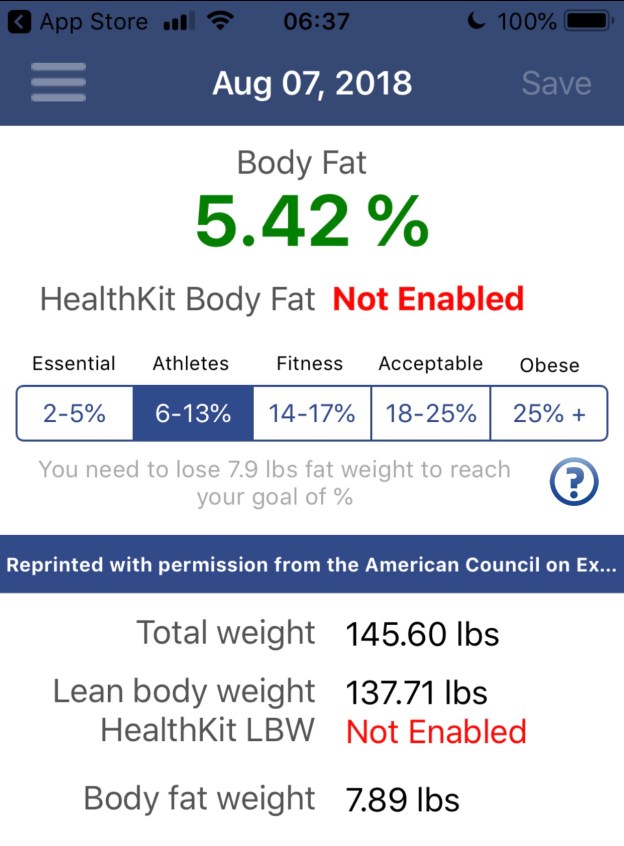
I took a look at myself in the mirror at 23% and didn’t like what I saw. I looked like a round, slightly lumpy snowman. I knew what I could look like when healthy and fit. I knew it was going to take some work to get back. It did! I’ve journaled about that process here, so you can look back at those blogs if you’d like. The picture I’ve included in this entry is a screenshot I took this morning from a body fat calculator on my mobile device. To use the app you still need body fat calipers, and, yes, you need to weigh yourself. Currently I weight around 145 and am carrying about 5.5% body fat. Did I mention I’m 56 years old…

If your sex is male, and you’re not an elite athlete, then you should aim for 10-15% body fat. If your sex is female and not competing in some sport, aim for 20-25%. If you need to be leaner for a sport (I am a martial arts instructor), then you may seek to go lower. However, men shouldn’t get below 4% or women below about 9%. You do need some body fat. I am keeping mine between 5-7% because I want to stay at that level of fitness to teach my karate’ class. That, and I like how I look and feel when I’m this lean.

So, what’s the secret? Did I do Keto? Count calories? Fasting? Run an hour a day? Overall friends, although it’s hard at first to apply the self-control, the concept is really very simple: you get fatter when you eat more, and you get thinner when you eat less. You also get fatter when you’re less active, while still eating the same, and you get leaner when you’re more active without increasing the amount you eat. Everything accumulates over time, fitness or fatness.

Duh? Well, why do we read so much disinformation when it comes to this? People want to believe, “You can eat whatever you want and lose the weight!” No, you can’t. Don’t buy it (metaphorically or literally). There are many paths to the goal of losing fat, and there are variables, but the truth is your body carries more fat when it doesn’t burn the excess (yes, I’m going to use a bad word here) CALORIES you’re consuming.

So, do you want to get fit? Start with your diet. You need to establish a healthy diet. If you want less fat, then you need to eat fewer calories. You need to cut out the sugar and starch. You need to schedule your eating.

Next, you need to move more. Find a form of exercise you will do regularly: walk, swim, bike, lift weights, get into an aerobics class, learn and practice a sport like basketball or an art like karate’ or yoga. Aim for 30-40 minutes of vigorous activity five or six days per week.

Do you want help? Coaching? I’m considering doing that for people in the near future, so stay tuned…