Category Archives: Biography

People Pleasing Pastor

I’ve never been one to overtly seek to people please, but I certainly do like to be liked and would love to be loved. I just don’t want that to be a part of my reputation. Let me tell you a secret that’s not really much of one, though. We pastors have to be people pleasers to a degree or our churches will be empty. We have to be political. We cannot always, or even usually, be candid. Why? I don’t know why I’m telling you what you already know. People don’t want the truth, even the ones who say they do. They want an image. They want their existing beliefs and prejudices reinforced. The speaker who can do that well will have a large listening audience.

I have tried to please people. I have tried to please everyone in my church. I have done a bad job. Our church was started to reach people who don’t go to church. That can be young or old, but early on we had a ministry to youth, largely. As the church has matured we have attracted older people, and I’ve sought to make this an environment to, well, please them.

Our band can be loud, so I sought to control the volume by building a room for the drummer. I led our church to purchase nice carpet to replace the old, chairs to replace the ancient theater seats that were once bolded to the floor. I’ve tried to have services at various times: early Sunday, Saturday evening. We’ve done campaigns by Rick Warren, which some of the people I was trying to please disliked. Nothing works. The people I’ve sought to keep happy aren’t and do not stay. I just don’t have what it takes to keep them.

I’m not from the South. I’m not a Texan. I’m not married. I don’t have kids. I preach too long. I don’t know, but, obviously, when we keep losing people to larger and/or established churches (ironic since our church is nearly 15 now). There are times when I’m ready to move back out West. Start another church. Leave the ministry altogether. I don’t know. I just want to do God’s will, and I’m tired of trying to please these people!

Stuff happens. In any human community, and that includes churches, there are conflicts, issues to resolve, feelings to assuage. What gets old is the tendency to blame the pastor for all of it. We do this with leaders. Look at how people seem to believe that the President of the U. S. A. is somehow to blame for all of the nations problems. You might be surprised at how little the man can actually do. As leaders we must take responsibility, however. We have to try to solve problems, but that doesn’t mean we are the problem. Now, that doesn’t mean I have no issues or am not a contributor to difficulties. I try not to be. I want to help, not cause or exacerbate problems.

I have come to the conclusion that I cannot please everyone. There are people who are intractable, incorrigible, and implacable. There are also great people who just don’t agree with me, or like me, or who perpetually take me the wrong way. I have to accept that and love them anyhow. I have to allow that some will join our church and then will eventually chose to go somewhere else.

Now, will that conclusion (that I cannot possibly please everyone) stop me from trying? I hope so. I’m not giving myself permission to be unkind to people, nor am I validating a self-centered approach to relationships. Love must be the basis for every human relationship. I will seek to love people. However, love doesn’t mean I must always try to do what makes others happy. Love means doing what’s best for others, even if I don’t like it: even if they don’t like it. “Love rejoices with the truth” (1 Corinthians 13:6), so I must be willing to tell the truth to others, although that’s painful to them and to me at times.
“I am what I am by the grace of God, and his grace toward me was not without effect” (1 Corinthians 15:10). I’m not Super Pastor. I’m just Pastor D. I’ll be me. I’ll let Christ do his work through my personality. I’ll keep learning and growing and changing where I need to become more Christlike. But I’m going to stop trying be someone or something I’m not, even if that means my church never gains MEGA status.


Vindication Part 7 MONEY

This is the seventh chapter in a series about 21 years of overcoming conflict and opposition as I’ve tried to learn how to minister and speak the truth in Garland, Texas. You can read the first six parts at www.deorl.wordpress.com or in my notes on www.Facebook.com/deorl.

Money, money, money, if only I had enough money.

I started college in the Fall of 1980. I enrolled in a small Christian school called Grand Canyon College (now a university). It was inexpensive when compared to many other private schools, which is to say it is expensive when compared to most state sponsored schools. I took out student loans to pay for my education. I am still paying off those loans.

I transferred to Baylor University in 1982. It is a magnificent school. It is also quite a bargain when compared to comparable public universities. It remains quite expensive. I’m still paying off those loans as well.

Unless you’re a mega-church pastor with a book deal, you are not going to make a lot of money doing ministry (assuming you stay honest). Until recently I’ve been paying into a retirement account. I started investing small amounts in this annuity when I entered full-time ministry in 1992. I stopped paying into it because I cannot afford it at this time. No big deal, since I wouldn’t be able to retire for even a full year on what’s in the account. Many ministers in the denomination with which our church cooperates cannot retire comfortably.

When I entered seminary I started carrying medical insurance through the denomination. This year I had to stop paying for that too. It was a good policy, but it has become increasingly  cost-prohibitive as I’ve grow older.  To top it off, Blue Cross/Blue Shield will not pay for hearing aids. You can complain all you want about Obamacare, but it had nothing to do with this situation. Something needs to be done for people to be able to afford to go to the doctor.

I’d just enjoy having the funds to to pay the rent on our church building every month. It would be wonderful to be able to support more missions, and start some churches. Ministry requires money.

I refuse to manipulate or take advantage of people in order to collect more donations. I had a worldly-wise member who told me one time: “tend the sheep, milk the goats.” This means use the people who give larger amounts of money, even if they are cantankerous, but focus your energy on those whom you’ve been called to shepherd. The temptation to do this is not a problem for me. People who don’t like me, just leave without further ado, and I don’t go chasing them down.

I will not make visitors feel like they should give. I don’t keep tabs on which members are giving either. This may seem impractical, even foolish. However, many people are turned-off about church and Christianity because of preachers who constantly ask for money.

I do believe in tithing. I didn’t for a long time. I used to think it was legalism. Oh, I gave. I felt like quite the sacrificial youth minister when I would buy things our ministry needed. What I discovered is, that’s not the same thing. I read a book by Robert Morris called The Blessed Life wherein the mega-church pastor demonstrated that the tithe represents giving the first and best to God. Giving the tithe was practiced before the Law of Moses, most notably when Abraham gave Melchizedek a tithe of the spoils he took in a battle (check Genesis 14:18-20). In other words, the tithe is an act of worship, not an attempt to please God by keeping the Law.

My tithing affects the entire church. They don’t realize it, but since the pastor got serious about tithing consistently about 10 years ago, our finances improved remarkably. I also started taking up an offering regularly during the worship service around this same time. Prior to that I’d been known to forget to ask for an offering at times.

We’ve gone through some difficult periods in my church, but God’s always pulled us through. I am grateful. I’d just like to stop having to worry about where the money will come from to pay all of the bills. In the last year and a half I’ve been depressed about this issue many times.

Honestly, I’ve been ready to leave the ministry and do something else. Really. Money problems will burn a minister out fast, and they can end a church. I told God that I’d quit if that’s what he wanted. I told him I’d teach school, or work for someone else, whether in our out of ministry. I just want to do God’s will. If I’m the problem, then remove the problem. No problem.

Every Sunday church attendance is a moratorium on my preaching. One week we have a full house. I preach to challenge or encourage or teach. It seems people are responsive. The next week we have half as many people in attendance. This is depressing, but it’s also a great burden because we have to pay the bills. I wonder, “where is the money going to come from?”

Don’t get me wrong, we have an amazing small core of individuals and families who do all they can to support our church. I have to worry when anyone leaves because it may mean we cannot pay our rent, support a mission, or give as much to the needy. I’d love to pay other ministers in our church who could use some help. This may not happen if people leave for the big church down the street.

So, why do I continue? I believe. I trust God. This will not continue. It cannot. It is a test. Will I, will we, stay faithful, or quit? Will I believe the promises in God’s Word? I am choosing to say yes, even though there are confounding variables and contradictory evidence at times.

Recently we’ve seen a number of people commit their lives to Christ. That is encouraging. Will they keep the commitment? In other words, do they really have faith? That’s not my call. However, it contributes to whether this church will continue to grow. I read a quote by Rick Warren today (I used to discount Rick Warren’s ministry as too unlike ours to be helpful. Actually, I’m just jealous). He spoke to pastors about their churches when he said, “You’re either a Risk taker, a Caretaker, or an Undertaker.” The last two are not good. A Caretaker is just keeping the status quo, keeping the members happy, not doing anything to elicit growth. An Undertaker is shepherding a dying church. Heaven forbid! So, I’ll pray about where and when and how to take risks to bring about growth.

I’ll end with some of those promises.

“Though the fig tree should not blossom

And there be no fruit on the vines,

Though the yield of the olive should fail

And the fields produce no food,

Though the flock should be cut off from the fold

And there be no cattle in the stalls,

Yet I will exult in the Lord,

I will rejoice in the God of my salvation.

The Lord God is my strength,

And He has made my feet like hinds’ feet,

And makes me walk on my high places.”

(Habakkuk 3:17-19, NASB)

“Honor the Lord from your wealth

And from the first of all your produce;

So your barns will be filled with plenty

And your vats will overflow with new wine.”

(Proverbs 3:9-10, NASB)

“Give, and it will be given to you. They will pour into your lap a good measure—pressed down, shaken together, and running over. For by your standard of measure it will be measured to you in return.”

(Luke 6:38, NASB)

“Each of you should give what you have decided in your heart to give, not reluctantly or under compulsion, for God loves a cheerful giver. And God is able to bless you abundantly, so that in all things at all times, having all that you need, you will abound in every good work.

(2 Corinthians 9:7-11, NIV)

I believe Lord, help my unbelief (and unfaithfulness).

Vindication 5 Who Is Deaf Like My Servant?

This is the fifth chapter in a series about 21 years of overcoming conflict and opposition as I’ve tried to learn how to minister and speak the truth in Garland, Texas. You can read the first four parts at www.deorl.wordpress.com or in my notes on www.Facebook.com/deorl.

In the early years of our church’s existence we were seeking an identity and a home. I thought we knew who God had called us to be and to whom he had called us to speak and serve. We were refugees who had been called to the rebellious who didn’t like church. We started out meeting in a rented house in Richardson, Texas, as well as hotel ballrooms. Regarding the house, there was some conflict with neighbors and the City of Richardson over our Bible studies and band practices. We were told by the city that we couldn’t have worship services in the house. Well, we were only doing Bible studies there, but there were complaints about that. We had two neighbors that liked us and two that didn’t. Complaints get the attention of city officials and they use zoning laws to limit free speech and free exercise.

We found an old movie theater in Garland, Texas and moved everything there. It was large, which would work well for our dramatic productions, but it had been unoccupied for at least 10 years. Many things had to be done just to bring it up to code. We took out a loan to do the necessary renovations. I really thought we’d be able to grow enough to pay the loan back quickly. However, as it turned out, the age of the building and an uncooperative owner kept us from having an inviting facility where people would worship.

We spent a lot of money getting the air conditioning to work in the building, but when the first winter hit we discovered the building did not have working heat either. This was something an unscrupulous leasing agent had kept from us. When we requested help from the owner, he offered to loan us money to fix the heating in his building. The payments for this five thousand dollar loan would conveniently be added to our rent. Even if this were fair, it wasn’t feasible for us. We were already struggling to pay the rent.

So, our little community froze through two winters in the old theater. During one of those winters I and our worship leader were living in the building as a cost saving measure. It was shortly after the movie Fight Club, and we saw this as our version of the dilapidated old house in which Edward Norton’s character lives. Did I mention it was cold? If you’re from a Northern state, then you probably think Texas cannot get that cold, but living in a building without heat in 30 degree weather is still harsh.

Worship services during these winters were interesting. We did a noon Bible study with brunch, and that happened either in the lobby or outside in front of the building. Our main worship time was at 6:00 P. M. Sundays. We tried various portable heaters, but the ceilings were 34 feet, so it really never got that warm. The few intrepid youths who came to worship huddled around those heaters and tried to pay attention to the service. This was not the best environment for worship attendance growth.

To compound the heating challenge, we also got flooded several times. Once during a drama production, it rained and a drain behind the building failed. Several of our scenes were flooded and we had to cancel the show that night. Neither the owner or the leasing company was willing to take responsibility for this. They did dig out the drain, but wouldn’t compensate us for lost revenue. At this point a little relief from the rent is all we were seeking. It would have even been financially wise on their part because it would have helped us remain in the building.

We had a three year lease, but there was a six month opt-out clause, which was put there by the owner, who was seeking to sell the building. After two years, and two cold winters, we had had enough. We gave our six-month notice in July, which meant we would be out of the building by December 31st.

On December 1st of that year I spoke about spiritual warfare during our Sunday evening worship time. I remember that it was a long message, and sitting on the floor to my right was a young man who would soon be shipped off to the war with Iraq. Warfare is primarily spiritual, even when it appears to be against material foes.

The next morning dawned a beautiful day; the sun was out, temperature was mild. Life, it seemed, was great. By mid-morning my perception of the day changed dramatically. The hearing in my right ear suddenly began to diminish. If I could make a visual analogy, it was as though I was inside a cave with bright sun coming in through the entrance. Then a door began closing like the iris on a camera, and it grew dark. As it got darker, I became more deaf. By 1:00 P. M. on December 2nd, 2002 I could no longer hear in my right ear.

To be deaf is a challenge. However, it was a shock to me because I’d always had good hearing. I do have tinnitus, loud ringing in my ears. This was the result of listening to a youth garage band years earlier. It was cold that day, so the teenagers in the band closed the garage door and turned up the amplifiers. I left with my ears ringing and they’ve never stopped. Up to this point, however, this affliction had not been overwhelming because outside noise usually drowned out the ringing.

Now my right ear was completely deaf to outside sounds. Complete deafness on that side would have been hard to take, but ironically I could still hear ringing in the ear, constant shrill ringing. Imagine if you were in a room where a loud smoke alarm is going off next to one of your ears, but you cannot stop it, or leave the room.

As I grew deaf, I also grew dizzy. I experienced a severe case of vertigo. I had to lay down to keep from vomiting. For a week, whenever I moved my head the room spun in the same direction. This was hell. In fact, as I lay there, perfectly still, I had time to think about hell, and what many Christians say it will be: eternal conscious torment. I could not imagine something so horrible. It changed my perspective. Something I may write about another time.

Thankfully, I believe in a good and loving God who hears prayer. I complained. I cried out. I begged God to help and heal me. I went to the doctor and received minor relief in the form of anti-vomiting medication, but the vertigo continued. I read the Bible and believed God directed I apply a promise from Revelation 2:10. It was originally a promise for the church in the ancient city of Smyrna. It reads: “Don’t be afraid of what you are about to suffer. The devil will throw some of you in prison to test you. You will suffer for ten days. But if you remain faithful even when facing death, I will give you the crown of life.” I was surely imprisoned by this strange affliction. I came to believe that the torment would last no longer than ten days. By the tenth day the vertigo was barely noticeable, so perhaps this was an accurate understanding of what the Holy Spirit promised me through the Bible. However, I wasn’t completely healed.

To this day I am almost completely deaf in my right ear. The ringing is loud and incessant: every waking hour, every single day since December 2, 2002. Thankfully, God grants me sleep and I do not hear the ringing then. I often have to strain to hear what people are saying during a conversation because the ringing is as loud as most people speak. When I try to play music or direct sound into that ear through headphones it irritates something and the ringing will become briefly louder.

On several occasions tinnitus in my left ear has flared up and become so loud that I have been terrified the same thing might happen. That would be for me the realization of hell on earth: not just deafness, but constant torment because of unimpeded ringing in both ears. I am trusting God not to allow something so horrific to happen. When I fear the other ear may close up, I cry out and trust my good and loving Father

The only thing that keeps me sane in the midst of constant affliction is the hope that God is good, he loves me and does not intend to harm me. He will not permit evil to overcome me. I remember his promises. I cling to them. I hold God accountable to keep his word.

” So do not fear, for I am with you; 

do not be dismayed, for I am your God. 

I will strengthen you and help you; 

I will uphold you with my righteous right hand. 

“All who rage against you

will surely be ashamed and disgraced;

those who oppose you

will be as nothing and perish.

Though you search for your enemies,

you will not find them.

Those who wage war against you

will be as nothing at all.

For I am the Lord your God 

who takes hold of your right hand 

and says to you, Do not fear; 

I will help you.”

(Isaiah 41:10-13, NIV)

Vindication Part 3: Dirty Cops

This is the third installment in a series about 21 years of overcoming conflict and opposition as I’ve tried to learn how to minister and speak the truth in Garland, Texas. You can read the first two chapters in the series in my notes on Facebook.

Image

I’ve been accused of being negative. Sorry, I’m trying to be more positive. I think faith is positive. It just seems I’m always fighting some kind of adversity. Maybe that’s the case with everyone. Probably that’s the way it’s supposed to be. If everything is going well, if I’m not fighting anything, I become comfortable and I don’t grow. Of course, if growth is predicated on conflict, I should be a spiritual giant by now! There’s more to it than just dealing with affliction, offense and opposition. I have to overcome, and that won’t happen apart from Christ working through me.

House of Judgement 1998 was the most difficult project for which I had been responsible, until I started a church. How the church got started is a story all it’s own, and I’ve written about it previously.

My church was founded under unique circumstances. I didn’t just come up with the idea one day. Really, my hand was forced. It became readily apparent that I could no longer be part of the status quo in youth ministry (as if I ever was!). A vocal but influential minority at the church where I served previously were unhappy with my unorthodox methods of reaching teenagers. I made this worse by doing stuff like bleaching my hair and doing our youth meetings at a place called the ROC (instead of at the church– as if the church is a building, but that’s another discussion).

Everything came to a head on February 15, 1999 when I was pulled over by the police at 2:00 A.M. with a car full of young adults. When asked why, the officer in charge told me I had made an illegal u-turn. Okay. We had just returned from… Dunkin Donuts. Pretty shady place to take young people, I know. When the police officer asked the ages of the people in the car, one young person was about a month short of his 17th birthday, so he was technically in violation of curfew. I should have checked before I let him go with us, I know.

It was cold outside. The 16 year old in question was not dressed for winter weather, but the officers took him out of the car, searched him and kept him shivering out there. I was frustrated and made the comment under my breath (I thought) that they’d see me in court over this. That is one of the stupidest things I’ve ever done. Promptly, the senior policeman, who we will just call “Officer Lurch,” appeared at my window like a quantum particle. “What did you say?” he demanded. I repeated myself. That may be the stupidest thing I’ve ever done.

“Step out of the car,” commanded Officer Lurch. He then made me spread eagle on the hood of his cruiser where he searched me. For what, I didn’t know. He put me in the back of the police car. No handcuffs. He and his partner spoke to the young adults in my car, and continued to keep the 16 year old out in the cold. Officer Lurch got into the front passenger seat of his warm police car and lectured me through the screen. He told me that they had the right to pull anybody over for anything they pleased at any time. At this point I had become wise enough to remain silent. The lecture about putative police rights lasted about 15 minutes.

At some point I was made aware that they had called the 16, nearly 17, year old passenger’s parents to come and get him. Since I wasn’t being charged with anything, –in fact, they never wrote me a ticket for the allegedly illegal u-turn– I asked if they’d let me out of the back of the police car before the young man’s father arrived. I didn’t need the guy thinking I’d done something wrong. Officer Lurch said, “We’ll see.” I could only watch helplessly when the young man’s father arrived and stared at me sitting like a criminal in the back of a police car. The man left with his son, then things got really interesting.

Officer Lurch came to the back of the police cruiser and commanded, “Step out of the car, please.” I complied. “Step around to the front of the car please.” I complied. As I was escorted to the front of the car by Officer Lurch, his rookie partner, who we’ll call Officer Buzz, circled around behind me, pushed me down on the hood of the cruiser and snapped handcuffs tightly on my wrists. Next–as in after I was cuffed–Officer Lurch circled back to the open door of the police car (not my car), and in one fluid movement appeared to reach into the back seat to remove a small plastic baggy with a dark substance in it. He walked up to me and shook the baggy in my face. “You’re under arrest for possession of marijuana!”

Officer Lurch, then turned toward the shocked passengers in my car and waved the baggy. Taunting with a smirk, he said: “See, your youth minister is a doper!”

I thought, ‘This can’t be happening!”  It was like I’d been dropped into the middle of some B-rated cop show.  I didn’t know what to say, so I shouted, “I’m being framed!”  as the dirty cops put me back (now handcuffed) into the police car. I was being framed. I guess they figured if I was going to see them in court, they’d give me a reason.

The officers then took charge of my car to have it towed, and made the remaining young adult passengers walk back to my apartment in the cold. I spent several hours in jail before I could post bail. I didn’t sleep, I assure you.

That week I spent money getting my car out of the impound, more money on a drug test within 24 hours, which proved I was clean. I even paid for at polygraph by a respected operator used by smaller police departments. The results? I was telling the truth when I stated: “The marijuana taken from the back of that police car was not mine.” I had to hire an attorney to present all of this. Once the Dallas County prosecutors office was confronted with the evidence, along with my clean record, they declined to pursue the case. The charges were dropped even before my arraignment.

Sadly, the information about my arrest got out, and there were those intent on ruining my reputation in the community. Gossip and rumor spread. “Did you hear about the youth minister who got arrested?” A member of our church heard the news from a police officer in line at the grocery story, another member heard it from someone at the bank. I had already informed our pastor of the incident, Next I held a meeting of all the youth parents and presented my case and the evidence of my innocense. The great majority of them believed me. I had spent seven years in that church as an honest, upright (and health conscious) associate pastor and youth minister. Later the same night I made the presentation to the rest of our congregation. Most of them believed my story, but not everyone.

Apparently, the disbelieving were vocal enough to have an impact. I was told by the pastor that my position would be reduced to part-time by the onset of summer. I was called to minister full-time. I had worked hard. I had done many good things at that church. What to do? I prayed.

I determined that God was calling me to start a church where people who felt unwanted, rejected and judged could come and find grace. I presented this idea to the pastor, and he was enthusiastic and supportive. We went to the local officials of the church’s denomination and they chose to sponsor the launch of a new church. On July 4th, 1999 City of Refuge was born in Richardson, Texas. We started with about 30-40 young people and a few adults. There was no model for this church, just the philosophy found in Jesus statement:

“It is not the healthy who need a physician, but the sick. But go learn what this means, ‘I desire mercy and not sacrifice.’ I have not come to call the righteous but sinners to repentance” (Matthew 9:12-13, NIV).

Everyone who attended received Christ’s unconditional acceptance. Many allowed his mercy and grace change there lives. There were also people who used this grace as a license to justify their bad behavior. It was a rough start. I wouldn’t recommend it to anyone. In fact, I could write an essay on how not to start a church.

In February of 2002 we determined that God wanted us to change the name of the church. Jesus taught that his followers are to be a light to the world like a city set on a hill. Zion is a name for Jerusalem in the Old Testament. It appears many times in connection with promises that God has made to his people. We are his people. His promises are for us. I don’t mean to say this about my church alone. All people who put their faith in Jesus have access to God’s “very great and precious promises” (see 2 Peter 2:2-4). Zion is a name that we hoped would remind the people of our church of this truth.

12 years later I started to notice that some people misunderstood the name Zion. Some thought it was Jewish, others associated it with Rastafarianism. Zion has a great biblical history, but too many organizations, good and bad, use it.  So, at the risk of appearing unstable, I proposed that we change the name one last time. I looked at the passage of Scripture from which we got our motto, “Spirit and Truth.” It is from the story about Jesus and the woman at the well. He promised a hurting outcast that if she asked, he would give her living water, water that would become a spring inside her, “welling up to eternal life.” Life Well. I want to live a Spirit filled, Christ focused life, and I want to receive the overflow of rich and satisfying life that Jesus offers to those who believe.  I want to help people to live life well. Now our church is called Lifewell and our new motto is “living life well.”

Along the way I’ve prayed that I would be vindicated, that my name would be cleared and my reputation restored. I had hoped one of those police officers somehow would have the conscience to come forward and tell the truth by now. Not yet, but I still have hope because I still believe the promises I received when I first came to Garland.

“So do not fear, for I am with you;

do not be dismayed, for I am your God.

I will strengthen you and help you;

I will uphold you with my righteous right hand.

All who rage against you

will surely be ashamed and disgraced;

those who oppose you

will be as nothing and perish.

Though you search for your enemies,

you will not find them.

Those who wage war against you

will be as nothing at all.

For I am the Lord, your God,

who takes hold of your right hand

and says to you, Do not fear;

I will help you.”

(Isaiah 41:10-13, NIV)

I suppose I could just forget about this terrible incident and move on, but the church I pastor is right around the corner from the church where I was youth minister when all of this occurred. We still do ministry at the ROC, a community center owned by that church. I have to believe that what happened to me was for a reason. God’s providence ensures that nothing takes place in the lives of any of his children apart from his approval. “God causes all things to work together for the good of those who love God and are called according to his purpose” (Romans 8:28). I do love God. I have been called. He has and will use this incident for good. I may not have had the courage to start City of Refuge if it wasn’t for what happened to me that cold February night in ’99.


Vindication Part 2

This is the second installment in a series about 21 years of overcoming conflict and opposition as I’ve tried to learn how to minister and speak the truth in Garland, Texas. You can read the intro to the series in my notes on Facebook.

I began ministry in Garland in November of 1992. I had just finished the fourth and most well attended year of a Halloween production I started in The Colony, Texas. It was called House of Judgement. I had no idea at the time how big this Christian dramatic alternative to the traditional haunted house would become.

In my last year in The Colony 2,000 people came through the house. In its first year in Garland, we exceeded that number when 2,250 came through. There was great support from the new church. A wonderful lady, who has since gone to be with the Lord, donated magazine quality flyers to publicize the event. Even still, during one of the performances one of the older volunteers seemed amazed at the number of people who were coming through the House. He confided that he had believed no more than a few people would be interested.

In 1994 people waited in line for hours to witness our Halloween drama and 4,650 came through. We had certainly outgrown the church facilities. Some church members complained: “How big are you going to let this thing get?” Every year many people prayed to receive Christ as the result of what they had witnessed. By this time hundreds of people had responded to our dramatic presentation. So, were we supposed to limit the number of people who heard the Gospel?

The following year was 1995 and the church graciously allowed us to use a recreation center it owned. Over 7,000 people came through the House. More than 10,000 attended when we held it at the same facility the next year. Our final year in this venue was 1997. We had the longest lines in our history, performed into the wee hours of the morning, and well over 11,000 people came through. I don’t believe we could have accommodated more.

Each year I wrote a different script for the production. If you are unfamiliar with House of Judgment, it is a morality play performed on multiple stages. An audience, typically of between 40-50 members, enters the House every 20 minutes or so, and watches the play by moving through a maze from stage to stage. House of Judgement stories were about the lives of teenagers who faced the earthly and eternal consequences of their choices. The story changed every year, but one thing remained the same: teenagers made choices that resulted in their deaths; those who believed in Jesus Christ went to heaven; those who rejected Jesus went to hell. We had some amazing, dramatic representations of heaven and hell!

We had stories about teenagers in gangs, boy-girl relationships gone bad, racism, drugs, suicide, and other issues faced by young people. Sadly, some in our church felt that these stories, and the language used by the actors was offensive. They wanted to edit the scripts. In 1997 I submitted my script to the pastor, who had others look at it. I received it back with portions circled in red, which reminded me of getting a paper back from the teacher at school. One of the memorable offenses I was supposed to remove was the following. A young person is at a party talking about another kid, whom he doesn’t like much. He explains why the other teen is late in coming to the party: “Yeah, he’s a trainer. Always stays late after games and kisses coach’s butt.” I was supposed to edit the phrase “kisses coach’s butt” because of how offensive it was. Thankfully the pastor saw how silly this was and the phrase stayed in the script. This is just an example of a problem that had been brewing for years. We were experiencing resistance and the erosion of support for a ministry that was reaching more and more people with a real and relevant Gospel.

The recreation center had its own board of directors, and they were not always happy with shutting the facility down for this production. Additionally, we probably didn’t return the facility to the condition they expected. I take responsibility for this. My only excuse is the extreme weariness of our key volunteers by the end of a production. We had plenty of people who wanted to be in the show, but few volunteers who wanted to clean up after. A little understanding would have been nice, though.

In 1997 we paid the recreation center for the use of the facility (even though it was owned by the church for which I worked). That year many, many people prayed to receive Christ because of our event. I remember going to the board meeting one night after the event concluded. I was very tired but excited to report the phenomenal number of people who attended and, more importantly, the large number who had responded to the Gospel in the counseling room. There was no enthusiasm from the board. None. I handed them a check for the rent and the treasurer took it without comment or commendation. They opposed us doing House of Judgement there again.

That was the last year House of Judgment was done under the sole authority of the church where I served. A wise woman at the church, who had founded a crisis pregnancy center, recommended that we become a non-profit organization. HOJ, Inc. was born.

In 1998 we encountered more opposition and difficulty than any previous year. We were essentially on our own. We had no building. We had no money. We did have many young people who were interested in acting, and plenty of volunteers ready to work. I had written a brand new script based, in part, on actual events and real people. It promised to be a powerful show. We began rehearsals in August of that year, even before we had a building. The recreation center was kind enough to permit us to use their facility for auditions and rehearsals. This was also the facility where I did youth ministry each week. By mid-September we still had no building in which to perform. The church that I served was too small and would not allow us to perform in their building in any case. We were also still not permitted to do it at the recreation center, even in an emergency. What to do? Where to go?

I searched and searched for a building large enough to accommodate the show, and which we could afford. Finally, we discovered an old shopping center in Richardson, Texas with an owner who was willing to rent it to us for a month. It would cost us far more than we would have had to pay the recreation center of my church, and it had been abandoned for a decade or more. However, I believed we could use it. There were no walls, so we could build our maze and scenes however we wanted. This was going to cost a fortune compared to previous House of Judgement productions. Where would the money come from? Not from my church, which had all but abandoned the project. I decided to open multiple credit card accounts and pay for it that way.

The biggest problem immediately facing us was time. We couldn’t get into the building until October 1st, but the show was scheduled to begin on the 12th. We were going to allow parents of our actors to come through that day as a kind of live dress rehearsal. So, we had 12 days, and three or four credit cards for capital. From this we would create the largest production we’d ever done. Thanks in large part to the leadership and hard work of two professionals who were in the construction industry we met the deadline… sort of.

Ceilings in the old grocery store were over 20 feet. Most of our scenes required a ceiling of less than half that height. Problem was, the fire marshall informed us that we couldn’t create a lower ceiling unless we also lowered the emergency fire sprinklers. This was cost and time prohibitive. As the result, all of our sets were left open at the top. This would present a significant noise challenge. Audiences in one scene would hear things going on in other scenes around them: dialog, music, screaming, gunshots. It was going to be a nightmare. I just hoped people who came through would be able to hear the dialog and get the message. Honestly, I was so discouraged that I never went through and watched the show that year. I was kept rather busy trying to get audiences through, anyhow.

When the first audience of parents and volunteers came through to test us out on October 12th, the final scene was still under construction! In House of Judgement the last scene is always hell. Our hell in 1998 was simple: it consisted of crosses that the condemned would be chained to, symbolic of their rejection of Jesus’ death on the cross. They would have to pay the penalty of their sins by suffering eternal death on crosses of their own. The first several audiences that entered could probably hear a chain saw cutting the telephone poles, which were being used to construct those crosses for the final scene. Construction finished before the first audience got to the scene, but it was certainly not what I’d planned, and I’m sure it wasn’t a terribly scary hell scene… yet.

The House was finished by the following weekend and we opened to the public. We began to see a response we’d never seen before. An average of one in every four people who came through House of Judgement 1998 indicated on a card that they prayed to receive Christ. In spite of all the difficulty and imperfection of the production that year, 13,500 people experience it.  We had 1,800 come through in a single Saturday night!

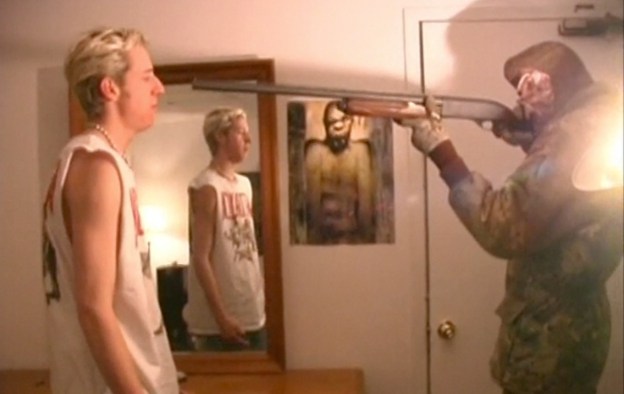
That year a videographer approached me about taping the show and turning it into a movie. The movie is called Dark Persuasion and can be viewed online at www.youtube.com/deorl